Talking to an insurance adjuster after an accident is one of the most consequential conversations you will have — and most people have it before they understand what is at stake. No matter how friendly the tone, the adjuster’s sole purpose is to protect the insurance company’s bottom line, not your recovery. What you say during that conversation can shape your entire insurance claim, including whether you are offered fair compensation or anything at all. This guide covers exactly what to say, what to avoid, and when to hand the call off entirely — so the first adjuster conversation does not become your most expensive mistake.

How to Talk to Insurance Adjuster After Accident: Understanding Who Is on the Line
A claims adjuster looks at the facts of the accident. They review police reports and photographs of the damage, medical records and driver notes. Their job is to find out what happened and if the policy covers the loss — and they are trained to find ways to pay as little as possible. The adjuster may sound genuinely sympathetic. The questions may feel routine. None of that changes what the call actually is: an evidence-gathering exercise designed to build a record that supports the lowest possible settlement.
Under California Insurance Code Section 790.03 and the California Fair Claims Settlement Practices Regulations, insurers are required to deal with claimants in good faith. But good faith does not mean generous — and it does not mean the adjuster is looking out for you. Knowing what they can and cannot do, and what you are and are not required to say, is the foundation of every rule that follows. For a deeper look at the specific tactics adjusters use to reduce payouts, see our guide on 5 tactics insurance adjusters use to lower your settlement.
Rule 1 — Confirm Only the Basic Facts
Your name, your contact information, the date and location of the crash, and how many vehicles were involved — that is the scope of what you should confirm. That is it. Every piece of information beyond those basics is a potential liability. The adjuster does not need to know where you were going, why you were at that location, who else was in the car, or what you were doing in the moments before the crash. Answering questions you were not legally required to answer is where most claimants create problems they spend months trying to undo.
If the adjuster tries to expand the conversation beyond these basics, the correct response is simple: “My attorney will be in contact with you to discuss the details of the accident.” You do not need to explain why. You do not need to apologize for not sharing more. The brevity itself is not confrontational — it is appropriate, and it is exactly what an experienced attorney would tell you to do.
Rule 2 — Never Describe Your Injuries in Detail
When an adjuster asks how you are feeling, it is not small talk. A simple “I’m fine” might be used to downplay your suffering later. Say that you are receiving medical care and refer them to your medical records for details. Avoid talking about daily life activities, symptoms, or progress in your own words. The adjuster is building a record, and your description of your injuries on day three after an accident — before the full extent of the damage is known — will be compared against everything your doctors document and everything you claim later.
Soft tissue injuries, concussions, and spinal conditions frequently produce delayed symptoms that do not appear until 24 to 72 hours or longer after impact. Describing yourself as “a little sore” on the first call, then reporting significant neck and back pain a week later, gives the adjuster exactly the inconsistency they are looking for. The safe response to any injury question is: “I am still being evaluated by my doctor and cannot comment on my medical condition at this time.” See our post on why whiplash symptoms can take days to appear for more on why early injury descriptions are almost always incomplete.
Rule 3 — Never Apologize or Admit Fault
Even a polite “I’m sorry” can be twisted into an admission of liability. California’s pure comparative negligence system means that every percentage of fault assigned to you reduces your compensation by the same proportion. A casual apology — which most people offer out of instinct, not because they believe they caused the accident — becomes part of the evidentiary record and can be used to assign you a fault percentage you do not deserve.
The same principle applies to any statement that acknowledges shared responsibility, expresses uncertainty about what happened, or describes your actions before the crash in ways that could be interpreted as contributing to the collision. Although adjusters might ask questions like “What do you believe caused the crash?” or “How fast do you think the other driver was going?” it is best not to guess and to mention only clear facts. If you do not know something with certainty, the correct answer is “I don’t know” — not an estimate or a guess. Our post on how comparative negligence in California affects your payout explains exactly why even a small fault admission has real financial consequences.
Rule 4 — Decline the Recorded Statement
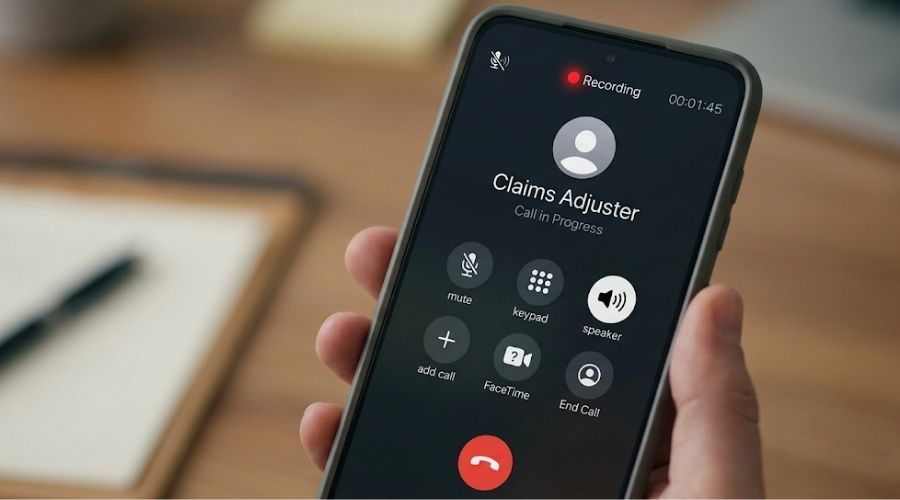
One of the first things many adjusters request is a recorded statement — a recorded phone call in which you describe the accident and your injuries in your own words. You are not legally required to give one to the other driver’s insurer, and declining is not confrontational or suspicious. If the adjuster asks for a recorded statement, you can say: “I am not comfortable giving a recorded statement at this time. My attorney will contact you to arrange communication.” Recorded statements are often used to compare your answers against later testimony, creating opportunities for the insurer to find inconsistencies that can harm your claim.
Your own insurer’s policy may include a cooperation clause that requires you to provide a statement to your own insurer — but even then, you have the right to consult an attorney before doing so, and doing so with legal counsel present or prepared is always the safer approach. The recorded statement is one of the most avoidable sources of claim damage, and declining it costs you nothing while protecting your ability to let the documented evidence — medical records, the police report, photographs — speak for itself.
Rule 5 — Never Accept a Settlement Offer on the First Call
Insurance adjusters sometimes offer a settlement during the first one or two phone calls. Quick settlements save the insurance company work — and money. They arrive before you understand what your injury claim might be worth. The timing of a first-call settlement offer is not a courtesy — it is a strategy. The offer arrives before your medical picture is complete, before future treatment costs can be projected, and before you have any basis for evaluating whether the number is fair.
Accepting a settlement offer triggers the release of your claim — permanently. Under California Civil Code Section 1542, that release typically waives your right to seek additional compensation even for injuries you had not yet discovered at the time of signing. No matter how reasonable the offer sounds on that first call, the correct response is: “I am not in a position to discuss settlement at this time. My attorney will be in contact.” For a full breakdown of why first offers are almost always undervalued, see our post on should I accept the insurance company’s first offer.
Rule 6 — Do Not Discuss the Accident Beyond Basic Facts
If the adjuster asks how the accident happened, say that your investigation of the accident is still continuing and that you will discuss the facts further “at the appropriate time.” This is not evasion — it is the accurate answer. Your attorney’s investigation of the accident may reveal facts, evidence, or liability arguments that you are not yet aware of. Describing the accident in detail before that investigation is complete locks you into an account that may be incomplete or that may inadvertently contradict evidence gathered later.
Adjusters are trained to ask open-ended questions that invite narrative responses — “Can you walk me through what happened?” is designed to get you talking at length. The more you say, the more material the adjuster has to work with. Keeping every response brief, factual, and limited to what you know with certainty is the consistent discipline that protects a claim throughout the entire process.
Rule 7 — Write Down Everything After the Call
As soon as your conversation is over, write down all the information you received over the phone, as well as whatever information you gave to or requests you made of the person with whom you spoke. Note the adjuster’s name, their direct phone number, the date and time of the call, every question they asked, and every answer you gave. This contemporaneous record becomes important if the adjuster later claims you said something you did not, or if their handling of your claim becomes the subject of a bad faith dispute.
Also note whether the adjuster made any representations about coverage, timelines, or your rights — because those representations may be legally significant. Under California’s Fair Claims Settlement Practices Regulations, adjusters are required to provide accurate information about your rights and coverage. If an adjuster misrepresented something to you — including telling you that you were required to give a recorded statement — that conduct is documentable and potentially actionable.
Rule 8 — Let Your Attorney Handle All Future Communication
Once an attorney represents you, the insurance company must communicate through them. This is one of the most immediately protective effects of retaining legal representation after an accident. The adjuster calls stop. The pressure to make statements ends. Every communication is managed by someone whose professional obligation is to protect your claim rather than minimize it — and whose presence signals to the insurer that the claim will be pursued seriously through the full range of available legal options if a fair settlement is not offered.
At Oracle Law Firm, our personal injury attorneys take over all adjuster communication from the moment you retain us. You do not have to manage another call, respond to another request, or worry about what you said. The strongest position in any adjuster interaction is having a lawyer who handles it for you — not a claimant trying to navigate a trained professional alone. For more on how the full claims process unfolds once an attorney is involved, see our post on how the personal injury settlement process works in California.

What to Say — A Quick Reference Script
For every common adjuster question, here is the response that protects your claim without being confrontational.
“Can you tell me what happened in the accident?” — “My investigation of the accident is still ongoing. My attorney will be in contact to discuss the details at the appropriate time.”
“How are you feeling? Are you injured?” — “I am still being evaluated by my doctor and cannot comment on my medical condition at this time.”
“Can I record this call / get a recorded statement?” — “I am not comfortable providing a recorded statement at this time. Please direct any further requests to my attorney.”
“We’d like to offer you a settlement today.” — “I am not in a position to discuss settlement at this time. My attorney will handle all settlement discussions.”
“Do you think the accident was your fault?” — “I am not going to speculate about fault. My attorney will be in contact.”
After giving your basic identifying information, every other answer on this list ends the same way. That consistency is not rude — it is the only approach that reliably protects the claim.
Frequently Asked Questions
Do I have to give a recorded statement to the insurance adjuster after an accident?
What should I say to an insurance adjuster after a car accident?
Can saying “I’m fine” to an insurance adjuster hurt my claim?
Can the adjuster from the other driver’s insurance company contact me directly?
Is the adjuster from my own insurance company working for me?
Adjuster About to Call? Talk to an Attorney First
The best time to talk to an attorney is before you talk to the adjuster — not after. Oracle Law Firm | Accident & Injury Attorneys handles all adjuster communication on behalf of injured clients throughout Southern California, with no upfront fees and no obligation. You only pay if we recover compensation for you. Contact our team today before the next call comes in.