Comparative negligence in California is the legal rule that governs what happens to your compensation when you share some responsibility for an accident. If you have ever been told by an insurance adjuster that you were partly at fault — and felt your claim slipping away — understanding this rule is the most important thing you can do. California’s system is one of the most plaintiff-friendly in the country, but insurance companies understand it just as well as attorneys do, and they use it strategically to reduce what they pay. Here is how it actually works.

What Comparative Negligence in California Actually Means
Comparative negligence in California means that partial fault reduces your compensation rather than eliminating it. California is a pure comparative fault state. Even if you were 99% responsible for an accident, you can still recover 1% of your damages. The rule was adopted by the California Supreme Court in 1975 in Li v. Yellow Cab Co., 13 Cal.3d 804, which abolished the prior “contributory negligence” system. Under the old contributory negligence rule, if an injured plaintiff bore any fault at all — even 1% — they were completely barred from recovering anything. California replaced that all-or-nothing system with a proportional one, and it remains one of only approximately 13 states in the country that use a pure comparative negligence approach.
The practical effect is significant. A plaintiff who was 40% at fault for a $200,000 injury still recovers $120,000. A plaintiff who was 60% at fault for a $500,000 injury still recovers $200,000. Cases that appear to have shared fault almost always have significant recovery value — a fact that insurance companies prefer injured people not to understand early in the claims process. According to the Insurance Information Institute, disputed liability is a factor in a significant share of personal injury claims, making comparative fault one of the most practically important concepts in California personal injury law.
How Fault Percentages Are Actually Assigned
Fault percentages do not appear from nowhere — they are either negotiated between attorneys and insurance adjusters before a case reaches trial, or assigned by a jury at trial using specific California jury instructions. The two most relevant instructions are CACI No. 405, which covers comparative fault of the plaintiff, and CACI No. 406, which covers apportionment of responsibility among multiple parties. These instructions direct jurors to assign each party — including the plaintiff — a percentage of responsibility based on the evidence presented, with all percentages adding up to 100%.
Before any jury is involved, however, fault percentages are a negotiating tool. Insurance adjusters assess the evidence, form a view of how a jury might allocate fault, and make settlement offers that reflect their estimate of the defendant’s exposure after comparative fault is applied. This negotiation phase is where most cases are resolved — and where the quality of legal representation has the greatest impact on the outcome.
California vs. Other States — Why “Pure” Matters
The word “pure” in California’s system is what makes it plaintiff-friendly compared to most of the country. Most states use a modified comparative negligence system, which sets a threshold — typically 50% or 51% — beyond which a plaintiff is completely barred from recovering any compensation. In those states, a plaintiff found 51% at fault walks away with nothing. Four states — Alabama, Maryland, North Carolina, Virginia — and Washington D.C. still use contributory negligence, where any plaintiff fault bars recovery entirely.
California has no such threshold. A plaintiff found 75% at fault on a $100,000 claim still recovers $25,000. A plaintiff found 90% at fault on a $500,000 catastrophic injury claim still recovers $50,000. The absence of a bar is genuinely meaningful for injured people in complex accidents where both parties contributed — and it is one of the primary reasons defendants and their insurers push comparative fault arguments so aggressively in California. Every percentage point they successfully assign to the plaintiff reduces their payout by a corresponding amount, with no floor below which they can walk away entirely.
How the Math Works — Real Examples
The calculation itself is straightforward once you understand the structure. Your total damages are established first — the sum of all economic and non-economic losses documented in the claim. That total is then reduced by your fault percentage to arrive at your net recovery.
If your total damages are $150,000 and you are found 20% at fault, you recover $120,000. If the same $150,000 in damages is paired with a 40% fault assignment, you recover $90,000. If your damages are $300,000 and you are found 50% at fault — a disputed liability scenario where both parties bear equal responsibility — you recover $150,000. The key insight is that the fault percentage operates as a multiplier on your total damages, not a binary on/off switch. This is why fighting inflated fault assignments matters so much financially, and why the evidence gathered early in a claim has a direct dollar impact on the final settlement.
How Insurance Adjusters Exploit Comparative Negligence
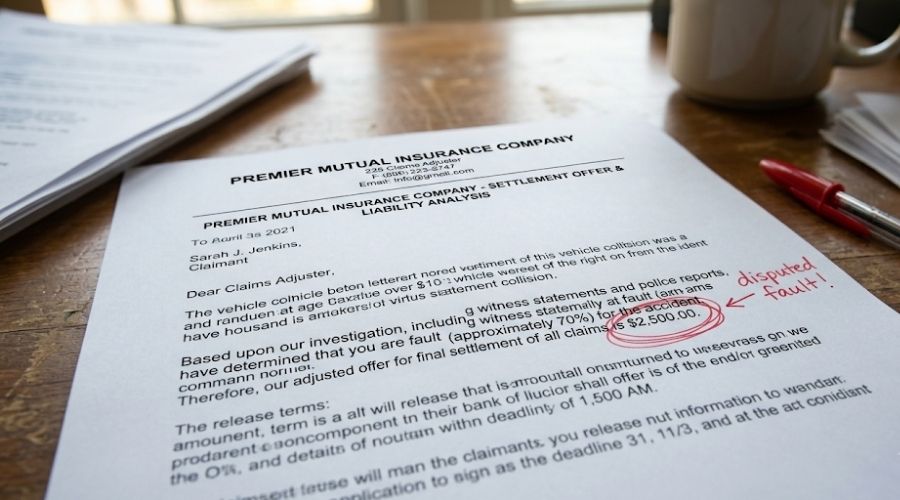
Insurance adjusters routinely overstate plaintiff fault to drive down settlements. This is not incidental — it is a deliberate strategy built into the claims process. Because every percentage point of fault assigned to the plaintiff reduces the insurer’s payout proportionally, inflating a plaintiff’s fault share from 10% to 30% on a $200,000 claim saves the insurer $40,000. The financial incentive to overstate fault is direct and substantial.
The arguments adjusters use are predictable. In car accident cases, they focus on speed, following distance, lane position, seatbelt use, or distraction. In bicycle and pedestrian cases, they point to helmet use, crossing behavior, or lighting. In slip and fall cases, they cite distracted walking or inappropriate footwear. In motorcycle cases, they invoke lane splitting or gear choices. This system encourages defendants to try to cast as much blame on plaintiffs as they can — and many injured people accept inflated fault percentages simply because they do not know those assignments can be challenged.
Challenging a fault assignment requires evidence — the same evidence that must be gathered early, before it disappears. Dashcam footage, witness statements, accident reconstruction analysis, police reports, and physical evidence from the scene all bear directly on how fault is apportioned. An experienced personal injury attorney knows which fault arguments are legally supportable and which are pressure tactics, and how to counter both with the right evidentiary response.
Proposition 51 — How Multi-Defendant Cases Work
When more than one defendant shares responsibility for an accident, California’s Proposition 51 — codified at Civil Code Section 1431.2 — determines how liability is allocated between them. The rule creates an important distinction between economic and non-economic damages.
For economic damages — medical bills, lost wages, property damage — defendants remain jointly and severally liable. For non-economic damages — pain and suffering, emotional distress — each defendant is only severally liable for their own proportionate share. In practical terms, this means that in a multi-defendant case, you can pursue one defendant for all of your economic damages regardless of how fault is split between the defendants. For non-economic damages, however, each defendant is only responsible for paying their own share — so if one defendant is insolvent or underinsured, you may not be able to recover their portion of the pain and suffering award from the other defendants.
This distinction matters most in cases involving trucking companies, commercial premises owners, and government entities, where multiple parties with distinct insurance policies may share liability for a single incident. Understanding how Proposition 51 will affect the allocation of damages across those parties is part of the strategic analysis an experienced attorney conducts before negotiating a settlement.
The Proposition 213 Exception — Uninsured Drivers
California’s comparative negligence system has one significant exception that operates separately from fault apportionment. Proposition 213, codified at Civil Code Section 3333.4, bars uninsured drivers from recovering non-economic damages in a personal injury claim — regardless of how low their fault percentage is. An uninsured driver who was 5% at fault and suffered $200,000 in damages can still recover their economic damages (medical bills, lost wages), but cannot recover any amount for pain and suffering, emotional distress, or loss of enjoyment of life.
This rule operates as an absolute bar on non-economic recovery for uninsured motorists — not a reduction, but a complete elimination of that category of damages. It is one of the most financially consequential rules in California personal injury law for drivers who were uninsured at the time of the accident, and it applies even when the other driver was predominantly responsible for the crash.
Comparative Negligence in California Across Different Claim Types
The same pure comparative negligence framework applies across every category of California personal injury case, but the specific fault arguments used by the defense vary by claim type. In car accident cases, the focus is typically on speed, following distance, and signal compliance. In bicycle accident cases, adjusters target lane position, helmet use, and hand signaling. In pedestrian cases, crossing behavior and distracted walking are the primary arguments. In slip and fall cases, footwear and phone use are the standard defenses. In truck accident cases, the presence of federal regulatory violations shifts the fault calculus significantly toward the trucking company — which is part of why those cases tend to settle at higher values despite comparative fault arguments.
Understanding that comparative fault arguments are tailored to each claim type — and that each type has its own specific evidentiary responses — is why case-specific legal experience matters. A general statement that you were partly at fault does not settle the question of how much. The percentage that gets attached to your name is negotiated, challenged, and ultimately decided based on the quality of the evidence and the skill of the advocate presenting it.

What You Should Do If You Are Told You Share Fault
Do not accept a fault percentage from an insurance adjuster without having it evaluated by an attorney first. An adjuster’s initial fault assessment is a negotiating position — not a legal finding, not a neutral determination, and not the final word. It is the insurer’s opening move in a process designed to minimize their payout.
Gather and preserve every piece of evidence connected to the accident — photographs, dashcam footage, witness contact information, police reports, and medical records. Each piece of evidence either supports or challenges the fault percentage the insurer is trying to assign to you, and its value diminishes quickly as memories fade and footage gets overwritten. Contact an attorney before you respond to any adjuster’s fault assessment, and before you accept any settlement offer that has comparative fault baked into it. At Oracle Law Firm, our personal injury attorneys evaluate fault assignments across all claim types and push back on inflated percentages with the evidence they require.
Frequently Asked Questions
What is comparative negligence in California?
How does fault percentage affect my settlement amount in California?
Can I recover compensation if I was more than 50% at fault in California?
What is Proposition 51 and how does it affect multi-defendant cases?
How do insurance adjusters use comparative negligence to reduce settlement offers?
Told You Were Partly at Fault? Talk to an Attorney Before You Accept Anything
A fault percentage from an insurance adjuster is a negotiating position — not a legal finding. Oracle Law Firm | Accident & Injury Attorneys evaluates fault assignments across all personal injury claim types throughout Southern California, with no upfront fees and no obligation. You only pay if we recover compensation for you. Contact our team today before you respond to any settlement offer that has comparative fault attached to it.