Rear-ended in Orange County — who pays for your injuries? The answer should be simple: the driver who hit you. California’s at-fault insurance system makes the rear driver legally responsible for your medical bills, lost wages, and pain and suffering in the overwhelming majority of rear-end collisions. But “legally responsible” and “actually pays” are two different things — and the gap between them is where most Orange County rear-end claims are won or lost. The rear driver’s insurer will investigate, dispute, delay, and negotiate every component of your claim before paying anything. Understanding exactly how the payment process works, what role your own insurance plays, and what to do before the adjuster calls is what this guide covers.
Rear-Ended in Orange County: How California’s At-Fault System Works
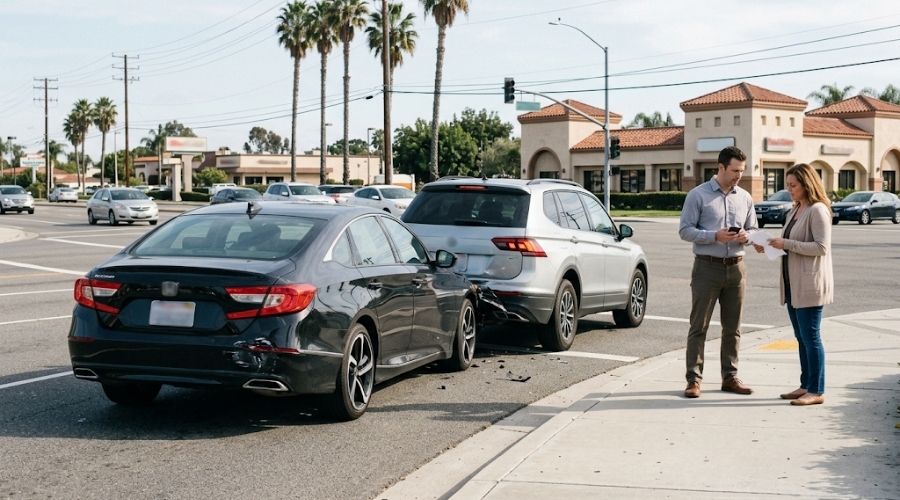
California is an at-fault state — which means the driver responsible for causing an accident is responsible for paying the resulting damages. In a rear-end collision, the rear driver is presumed at fault under California Vehicle Code Sections 21703 and 22350, which require drivers to maintain a safe following distance and travel at a speed appropriate for conditions. That presumption is rebuttable — the rear driver can challenge it with evidence — but in the vast majority of Orange County rear-end crashes, it holds.
In practical terms, this means you file a third-party claim against the rear driver’s liability insurance. Their insurer evaluates your claim, determines coverage, and pays up to the policy limits for your medical expenses, lost wages, property damage, and pain and suffering. Your own insurance is generally not the primary payer in a standard not-at-fault rear-end collision — but it plays important supporting roles, as discussed below. According to the California Department of Insurance, all California drivers are required to maintain minimum liability coverage — increased to $30,000 per person and $60,000 per accident under SB 1107 effective January 1, 2025. For a detailed breakdown of how the fault presumption works and when it can be challenged, see our post on who is at fault in a rear-end collision in California.
The Third-Party Claim Process — What Actually Happens
Filing a third-party claim against the rear driver’s insurer sets a specific process in motion. Under California’s Fair Claims Settlement Practices Regulations, the insurer must acknowledge your claim within 15 days of receiving it and must accept or deny the claim within 40 days of receiving all reasonably necessary documentation. During that window, an adjuster investigates the crash, reviews the police report and any photographs, evaluates your medical records, and forms an initial view of liability and damages.
The adjuster’s initial offer — when it comes — is almost never the last word. It is a negotiating position calibrated to the lowest number they believe you will accept. In Orange County’s rear-end claim environment, where the 405, 5, 57, and 91 freeways generate some of California’s highest rear-end collision volumes, adjusters handle these claims in high volume and apply standardized low-opening offers. Responding to that offer with documented medical expenses, wage loss records, expert opinions on future care, and a credible litigation threat is what moves the number. For more on what adjusters do to minimize payouts and how to respond effectively, see our post on 5 tactics insurance adjusters use to lower your settlement.
How the Adjuster Will Dispute Your Claim — Even in a Clear Rear-End Case
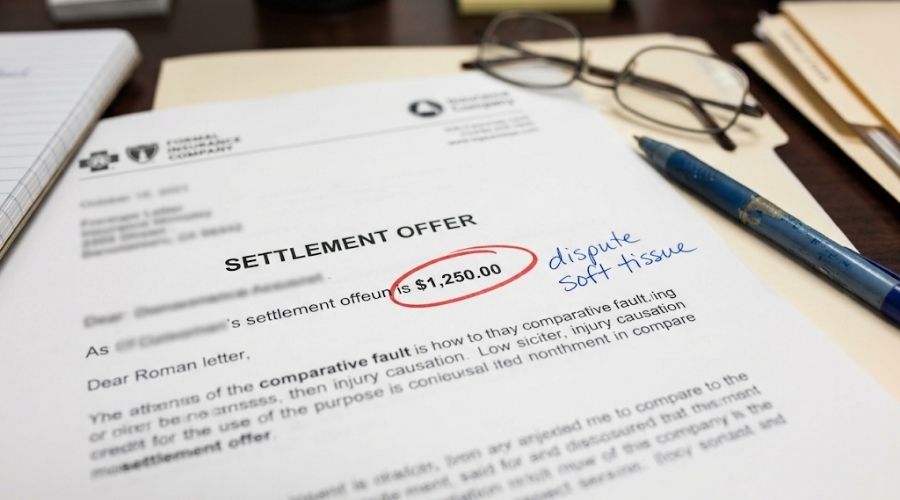
Even when fault is not seriously in dispute, the insurer for the rear driver has multiple tools for minimizing what they pay. The most common dispute tactics in Orange County rear-end claims target your injuries rather than liability — because attacking who caused the crash is harder when the physical evidence clearly shows a rear impact.
Injury causation arguments are the most common: the insurer argues that your soft tissue injuries, back pain, or neck symptoms were pre-existing rather than caused by the crash. Low-impact arguments follow: in minor-damage rear-end crashes, adjusters argue that the vehicle damage is too slight to have caused the claimed injuries — a position that California courts have consistently rejected when backed by medical evidence but one that unrepresented claimants frequently accept. Comparative fault arguments add a layer: even in a clear rear-end case, the adjuster may argue you contributed by braking suddenly, stopping without adequate warning, or having non-functioning brake lights. Every percentage point of fault they successfully assign to you reduces their payout by the same proportion. For more on how to challenge comparative fault assignments in rear-end cases specifically, see our post on what happens if you’re partly at fault for an accident in California.
When the Rear Driver Is Underinsured — How UIM Coverage Works
California’s minimum liability coverage of $30,000 per person is frequently insufficient for serious rear-end injuries. A rear-end collision that requires spinal surgery, produces a traumatic brain injury, or generates months of missed work can easily produce damages two, three, or ten times that minimum limit. When the at-fault driver’s policy is exhausted before your damages are fully covered, your own underinsured motorist coverage becomes the next recovery layer.
UIM coverage under California Insurance Code Section 11580.2 works similarly to UM coverage: your own insurer steps in after the at-fault driver’s policy pays its limits and covers the difference up to your UIM policy limits. The UIM claim is negotiated with your own insurer — which means the same dynamic applies as in a UM claim: your insurer has a financial interest in minimizing the payout, and the claim requires the same documentation and negotiation as any other insurance claim. Checking your own policy’s UIM limits — on the declarations page — immediately after a serious rear-end collision tells you what ceiling of additional recovery is available if the at-fault driver’s minimum policy is inadequate. For more on how UM and UIM coverage works in Orange County collisions, see our post on hit-and-run accidents in Orange County: what are your rights.
MedPay — Your Immediate Medical Bridge While the Claim Is Pending
The third-party claim process takes time — weeks to months for straightforward cases, and much longer for disputed or serious injury cases. During that period, your medical bills are accumulating even though the at-fault driver’s insurer has not yet paid anything. Medical payments coverage — MedPay — fills that gap.
MedPay is a first-party coverage on your own auto policy that pays your medical bills immediately after an accident, regardless of fault and regardless of whether the at-fault claim has been resolved. It covers emergency room visits, specialist consultations, physical therapy, and prescription costs up to the MedPay limit — typically $1,000 to $25,000. Filing a MedPay claim with your own insurer while the third-party claim against the rear driver’s insurer is being negotiated provides immediate financial relief without waiting for the investigation to conclude. Your insurer may assert a subrogation right against any eventual third-party recovery — meaning they may seek reimbursement for what MedPay paid — but that process does not affect your ability to use the coverage now. For more on all the coverage layers that may apply to an Orange County car accident claim, see our post on should I accept the insurance company’s first offer.
Orange County’s Rear-End Collision Corridors — Why They Matter for Your Claim
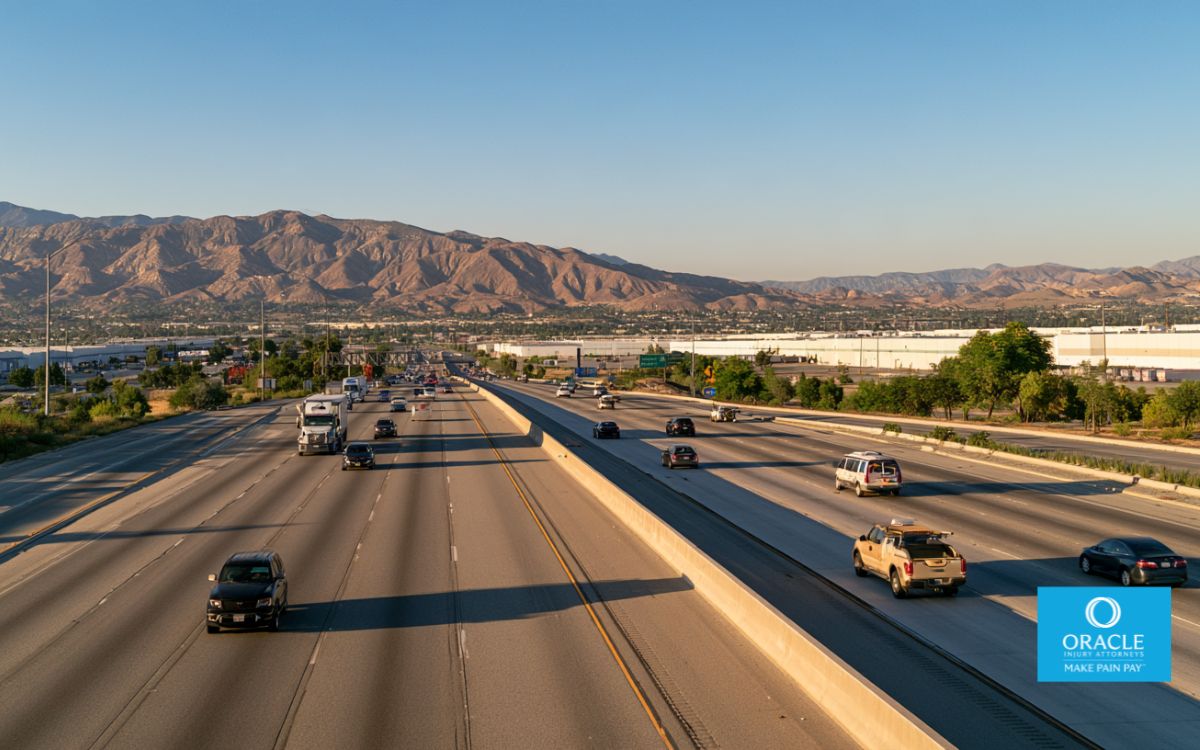
Orange County’s freeway network — the I-405, I-5, SR-57, SR-91, and SR-55 — generates some of California’s highest rear-end collision volumes on a daily basis. The 405 through Irvine, Costa Mesa, and Huntington Beach carries over 300,000 vehicles per day in some segments and produces rear-end collisions in its merge zones, construction corridors, and peak-hour bottlenecks with regularity. The 91 freeway through Anaheim and Corona produces high-speed rear-end crashes particularly at the interchange with the I-15 where commuter and freight traffic converge.
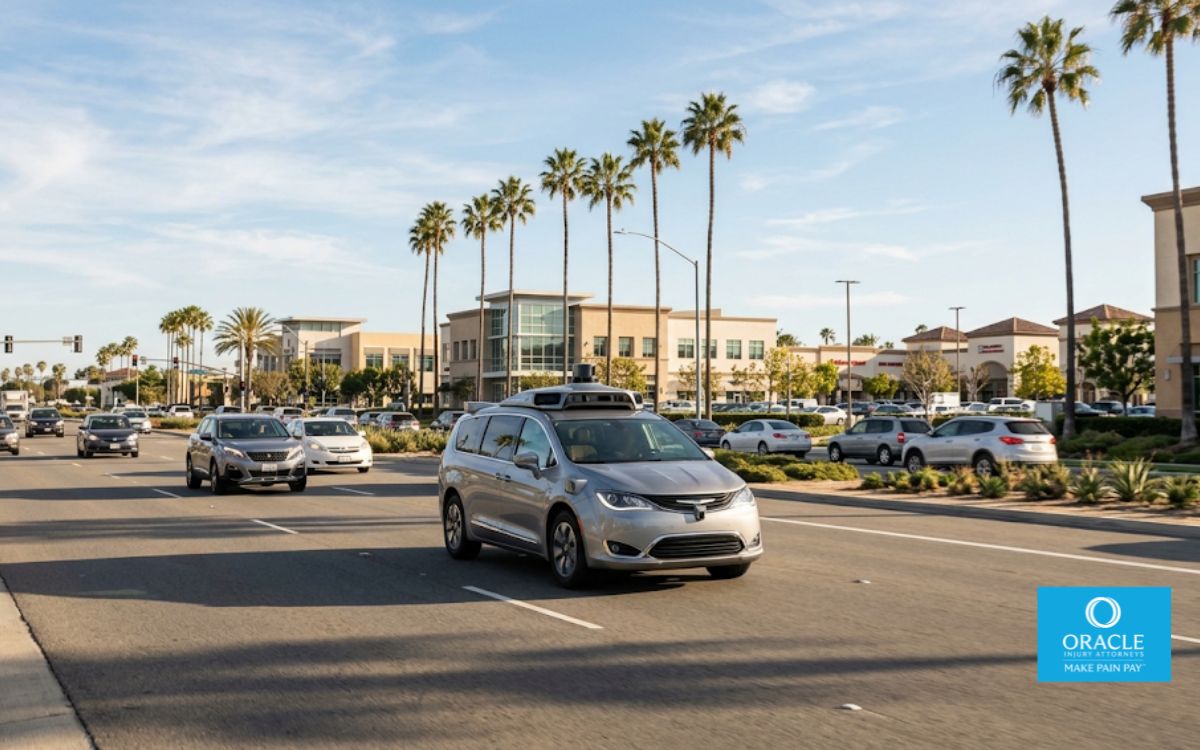
Surface street rear-end collisions in Orange County’s commercial corridors — Harbor Boulevard in Anaheim, Katella Avenue through Garden Grove and Anaheim, Bristol Street through Costa Mesa and Santa Ana — follow different patterns: lower speeds but higher pedestrian and cycling exposure, commercial vehicle involvement, and stop-and-go traffic around shopping centers and business parks. The specific road characteristics of the location where your crash occurred affect both the liability analysis and the evidence that is most useful in your claim — which is why an attorney with local Orange County court and crash corridor experience brings specific knowledge that a general practitioner does not. For a detailed explanation of the fault rules that govern rear-end liability on these corridors, see our post on who is at fault in a rear-end collision in California.
What Your Rear-End Collision Claim Is Worth in Orange County
Rear-end collision settlements in Orange County in 2026 range from $15,000 to $75,000 for soft tissue injuries — whiplash, cervical and lumbar strain, and minor disc involvement — when injuries are documented with consistent medical treatment and clear medical records. Disc herniations requiring epidural injections or surgical evaluation typically settle between $50,000 and $200,000. Cases involving spinal surgery, traumatic brain injury, or significant permanent impairment regularly settle for $500,000 to $1,250,000 and higher. The largest rear-end settlements involve multi-level spinal surgeries, permanent neurological deficits, and high-income wage-loss calculations — cases that have settled at $5,750,000 and above in California when all damage components are fully developed.
The gap between the insurer’s first offer and the eventual settlement in represented rear-end cases is consistently larger than the attorney fee — which is why representation in rear-end collision claims in Orange County produces better net outcomes for injured parties across virtually every injury severity level. For a full breakdown of how case value is calculated across all damage categories and how comparable Orange County cases have settled, see our guide on what your personal injury case is worth in California.

What to Do Before the Adjuster Calls
The adjuster for the rear driver’s insurer will call quickly — often within 24 to 48 hours of the crash. That call is not a courtesy check. It is an evidence-gathering exercise designed to capture statements that can be used to minimize your injuries or increase your assigned fault percentage. The same principle applies even if your own insurer calls first: they are also managing a financial exposure, and a recorded statement given before your full injury picture is known creates a permanent record that the claim must be managed around.
Before that call comes: seek medical attention the same day, even when injuries seem minor. Delayed symptom onset from soft tissue injuries and concussions frequently presents 24 to 72 hours after impact — and a medical record established close to the crash date is the strongest documentation of the connection between the rear-end collision and your injuries. Report the crash to your insurer but decline to give a recorded statement until you have spoken with an attorney. Photograph all vehicle damage, the crash scene, any visible injuries, and the positions of the vehicles before they are moved. And do not accept any settlement offer — including one made at the scene — before the full extent of your injuries is known. For a complete guide to handling that first adjuster call, see our post on how to talk to an insurance adjuster after an accident.
Frequently Asked Questions
Who pays for my injuries after a rear-end collision in Orange County?
How long do I have to file a claim after being rear-ended in Orange County?
What if the driver who rear-ended me has only minimum insurance in California?
What is MedPay and how does it help after a rear-end collision in Orange County?
Will my insurance rates go up if I was rear-ended in Orange County?
Rear-Ended in Orange County? Talk to an Attorney Before You Respond to the Adjuster
The adjuster is going to call. What you say — and what you do not say — in that first conversation shapes the entire claim. Oracle Law Firm | Accident & Injury Attorneys handles rear-end collision claims throughout Orange County with no upfront fees and no obligation. You only pay if we recover compensation for you. Contact our team today before any recorded statement is given or any settlement offer is accepted.