Most workers’ comp hearings in Orange County happen at the Santa Ana district office and are settlement conferences, not trials. A judge pushes both sides toward agreement. If that fails, the case goes to trial, where you testify and medical reports are the most important evidence. Written decisions usually arrive 30 to 90 days after trial.
The notice showed up in the mail with a date, a room, and almost no explanation. Now you are picturing a courtroom, a witness stand, and a lawyer in an expensive suit picking apart everything you said about your back.
Take a breath. A workers’ comp hearing in Orange County looks almost nothing like what you are imagining. There is no jury. There are no dramatic cross-examinations for most people. There is a judge, a hallway full of people waiting their turn, and a process that is far more administrative than theatrical.
That said, what happens in that building matters enormously to your claim. The insurance company will have someone there who does this type of work every week. Knowing how the day actually unfolds is how you stop being the least prepared person in the room.
Here is what you can expect, step by step. If your claim has already been denied or delayed, our workers’ compensation attorneys can tell you where your case sits in this process.
What Happens at a Workers’ Comp Hearing in Orange County?
Quick take: Most hearings are mandatory settlement conferences, where a judge meets with both sides and pushes for an agreement. Only cases that cannot settle move on to a trial, and even then, there is no jury and most of the evidence is paperwork.
The word “hearing” covers several different events in the workers’ comp system, and they are not interchangeable. Knowing which one you are attending changes how you prepare.
The three you are most likely to encounter:
- Mandatory settlement conference (MSC): The judge tries to get the case resolved. Most cases end here.
- Trial: Testimony under oath, exhibits, and a written decision from a judge.
- Expedited hearing: A fast-track hearing when you need medical care or benefits right now.
Where Your Hearing Takes Place
Quick take: Orange County workers’ comp cases are handled at the Division of Workers’ Compensation district office in Santa Ana, at 2 MacArthur Place, Suite 600, with morning and afternoon calendars.
The Santa Ana district office runs a morning session starting at 8:30 a.m. and an afternoon session starting at 1:30 p.m. Your notice will tell you which one. Plan for parking and security to eat more time than you expect, especially near the 55 and the civic center traffic that builds through downtown Santa Ana.
The same building houses the Disability Evaluation Unit and the Information and Assistance Unit. The I&A officers are state employees who answer questions for injured workers at no cost, and the office runs free injured worker workshops over Zoom, in English and in Spanish.
Worth knowing before you go:
- Some hearings are held remotely, so confirm the format on your notice rather than assuming.
- Bring photo identification and arrive early enough to clear security.
- Bring your file: medical reports, work restrictions, benefit notices, and correspondence from the claims administrator.
How Your Case Gets to a Hearing
Quick take: Nothing gets scheduled automatically. Someone has to file an Application for Adjudication of Claim to open a case, then a Declaration of Readiness to Proceed to request a hearing date.
If your claim was denied or your benefits stopped, the state’s guidance for injured workers whose claims were denied walks through the process. You file the Application at the district office covering where you live or where you were injured, and you serve it on the claims administrator.
The Declaration of Readiness to Proceed, usually called a DOR, is the document that actually puts you on the calendar. It tells the court the dispute is ripe and asks for a hearing.
What has to happen before a date appears:
- File the Application for Adjudication of Claim and serve the other side.
- Complete the medical record: treating physician reports and often a qualified medical evaluator’s report.
- File the Declaration of Readiness to Proceed, identifying the specific issues in dispute.
Nothing in workers’ comp gets scheduled on its own. Someone has to file the paperwork that starts the clock.
The Mandatory Settlement Conference, Step by Step
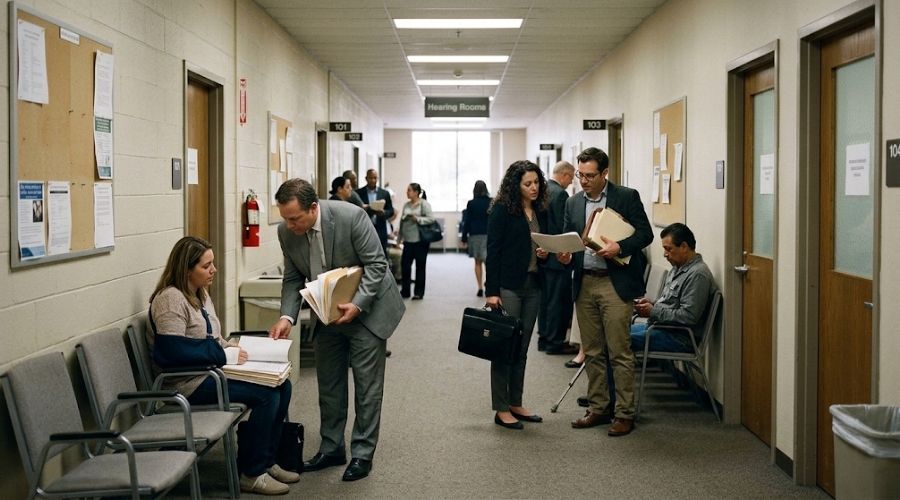
Quick take: At an MSC, a judge meets with both sides to try to settle the case. You will likely spend more time waiting in a hallway than talking to the judge, and most cases resolve at this stage.
The judge at your settlement conference will not try your case if it does not settle. That separation is deliberate: it lets the settlement judge speak frankly about the strengths and weaknesses of both sides without tainting a later trial.
Expect a lot of dead time. Cases are calendared in blocks, and attorneys negotiate in hallways while waiting to be called. Bring something to read and do not schedule anything tight afterward.
What actually happens during your MSC:
- The judge reviews the disputed issues and asks each side where they stand.
- Both sides exchange settlement positions, often with the judge relaying numbers between rooms.
- If the case settles, terms are put on the record and submitted for approval.
- If it does not settle, both sides complete a pretrial conference statement listing every issue, witness, and exhibit for trial.
That pretrial statement is more important than it looks. Evidence and issues not listed on it can be excluded at trial, which means a document left off the list may never be seen by the trial judge.
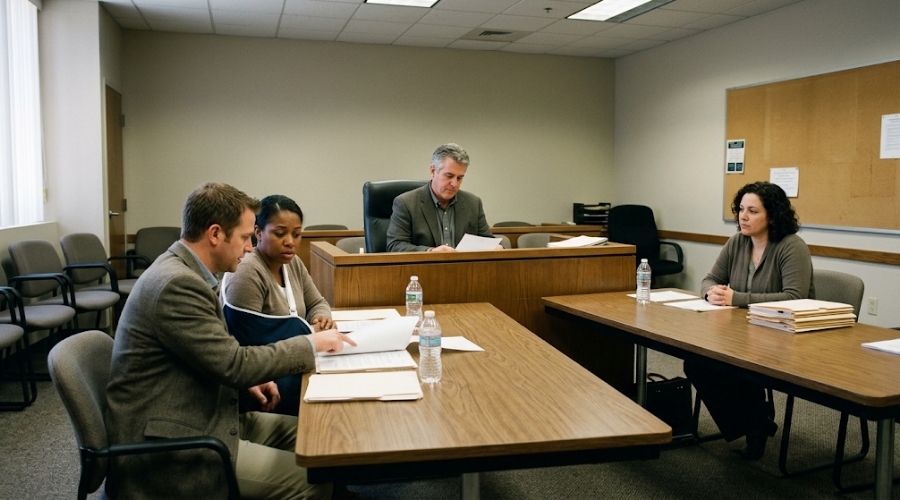
What a Workers’ Comp Trial Actually Looks Like
Quick take: A workers’ comp trial is a hearing before a single judge, with no jury. You testify about how the injury happened and how it affects you, but the medical reports are usually the most important evidence in the decision.
Trials are shorter than most people expect, often finishing in a single session. The judge takes testimony, admits the exhibits listed in the pretrial statement, and closes the record. Occasionally the record stays open for a supplemental medical report or a deposition transcript.
Your testimony matters most on the facts only you know: what you were doing when you got hurt, what you told your supervisor, and what you can and cannot do now. Answer the question asked, do not volunteer extra, and do not exaggerate. Consistency with what you have already told your doctors is what makes your testimony credible.
You will not walk out with a decision. According to the state, the judge issues a written decision that usually arrives between 30 and 90 days after trial. If you disagree with it, the next step is a Petition for Reconsideration, and that deadline is short.
Expedited Hearings When You Need Care Now
Quick take: If you are being denied medical treatment or temporary disability payments you clearly need, an expedited hearing gets you in front of a judge much faster than the standard track.
The regular hearing calendar moves slowly, and insurance companies know it. Expedited hearings exist to ensure that workers who cannot get authorized surgery or a wage replacement check do not wait months for relief.
They are limited in scope. An expedited hearing addresses urgent issues like entitlement to medical treatment or temporary disability, not the full value of your case.
When an expedited hearing is worth requesting:
- Authorized treatment has been cut off or denied and your condition is getting worse.
- Temporary disability payments stopped without a clear explanation.
- There is a dispute over which doctor or medical network controls your care.
What the Insurance Company Is Doing Behind the Scenes
Quick take: The claims administrator’s job is to close your file for as little as possible. Delay is a strategy, not an accident, because financial pressure makes injured workers accept less.
Understand the incentive structure and the tactics to stop feeling personal. Every month your case stays open; the carrier holds money it would otherwise pay out. Every month you go without full wages, your position softens.
Common patterns worth recognizing: an offer that appears in the hallway minutes before the MSC begins, framed as expiring today. Objections to your treating doctor’s reports that push the case to another evaluation and another six months. Repeated requests for records that were already provided.
None of that means your claim is weak. It usually means the opposite, because carriers do not spend money delaying cases they expect to win outright.
- A first offer is an opening position, not a valuation of your injury.
- Nothing offered at a settlement conference expires that day, whatever you are told.
- You are allowed to say you need time to review an offer before signing.
Delay is not a sign your claim is weak. It is a strategy aimed at your bank account.

Conclusion
Two takeaways. First, most Orange County workers’ comp cases resolve at a settlement conference in Santa Ana, not at trial, so the preparation that matters happens well before your hearing date. Second, the pretrial conference statement and the medical record largely determine the outcome, which means the work you do on paper decides the case more than anything you say out loud.
If you walk into a hearing unaware of the other side’s filings, you are at a disadvantage unrelated to the merits of your injury. Oracle Law Firm represents injured workers throughout Santa Ana, Anaheim, Irvine, and the rest of Orange County.
Been in an accident or hurt on the job? You don’t have to navigate insurance companies alone. Oracle Law Firm fights to get you the compensation, control, and clarity you deserve.
Get a Free Consultation or call 888.597.4099.
This article is for general information only and is not legal advice. Every case turns on its facts, and outcomes depend on the specific circumstances involved. Speak with an attorney about your situation.
Frequently Asked Questions
Do I have to attend my workers’ comp hearing in person?
It depends on the type of hearing and the current practice at the district office, since some proceedings are held remotely. Your hearing notice will state the format and location. If you are represented, your attorney will tell you whether your appearance is required, and for a trial where you testify, your attendance is essential.
How long does a workers’ comp hearing take in Orange County?
The hearing itself is often brief, sometimes under an hour, but they plan to spend most of the day at the district office because cases are calendared in blocks. Settlement conferences involve long stretches of waiting while attorneys negotiate. Trials usually finish in one session, though the record can stay open for additional medical evidence.
Will I have to testify at my workers’ comp hearing?
At a mandatory settlement conference, you usually will not have to testify. At a trial, you generally will testify under oath about how the injury happened, what you reported, and how the injury affects your daily life and work. Defense counsel may ask questions, but the tone is far less adversarial than a criminal or civil jury trial.
What happens if I lose at my workers’ comp trial?
You can file a Petition for Reconsideration asking the Workers’ Compensation Appeals Board to review the judge’s decision. The deadline is short and strictly enforced, so the decision needs to be acted on quickly. An attorney can assess whether the decision contains a legal or factual error worth challenging.
Can I settle my case at the hearing?
Yes, and most cases do settle at or around the mandatory settlement conference. Any settlement must be approved by a workers’ compensation judge, who reviews it to make sure the terms are adequate. You are never required to accept an offer made at a conference, and you can ask for time to review it.