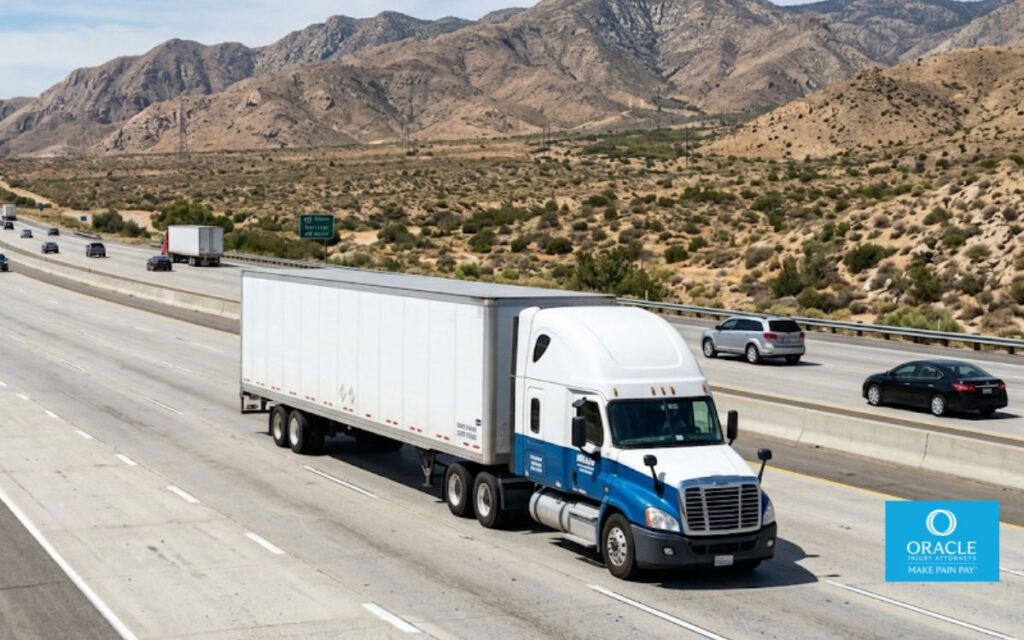
Truck accident claims in California are not simply larger versions of car accident cases. They activate an entirely separate legal framework — one that layers federal regulations on top of state personal injury law, involves multiple potentially liable parties instead of just one driver, and puts injured victims up against commercial insurers carrying policies worth hundreds of thousands to millions of dollars, defended by legal teams that specialize in exactly this type of claim. Understanding what makes truck accident cases different is the foundation of protecting your rights after a crash.
The Scale of the Problem on California Roads
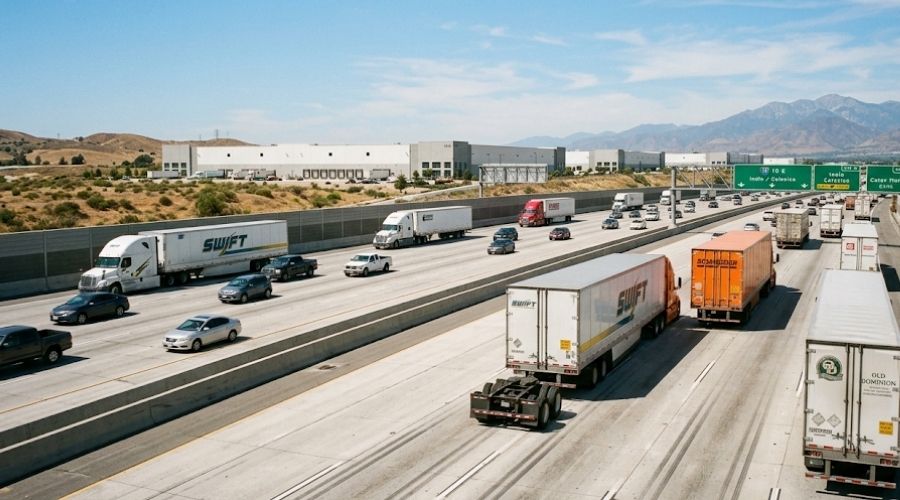
California is one of the most active commercial trucking states in the country, with major freight corridors running along Interstate 5, Interstate 10, Interstate 15, and Highway 99 connecting ports, distribution centers, and agricultural regions across the state. California recorded approximately 10,500 commercial truck crashes in 2025, with 392 truck fatalities in 2023 — placing it second nationally for fatal truck crashes. De acuerdo con la Administración Federal de Seguridad de Autotransportes, large truck occupants and the people they hit sustain injuries at a rate and severity that consistently outpaces standard passenger vehicle crashes.
The injuries that result from these crashes reflect the physics involved. A fully loaded semi-truck can weigh up to 80,000 pounds — roughly 20 times the weight of a typical passenger car. At highway speeds, the force involved in a collision produces injuries that bear no resemblance to what a standard car accident generates: traumatic brain injuries, spinal cord damage, multiple fractures, internal organ trauma, and fatalities at rates that dwarf equivalent passenger vehicle collisions.
Truck Accident Claims California: The Federal Regulatory Layer
Truck accident claims in California do not just trigger state personal injury law. A truck accident in California activates a second legal system written in Washington, D.C. The Federal Motor Carrier Safety Administration sets binding rules on driver hours, vehicle maintenance, and minimum insurance that directly shape your claim. When those rules are broken, the violation itself can establish negligence under California Evidence Code Section 669 — shifting the burden of proof to the trucking company.
Federal Motor Carrier Safety Regulations, codified at 49 CFR Parts 390 through 399, impose detailed requirements on interstate motor carriers covering driver qualification, hours of service, vehicle inspection and maintenance, cargo securement, drug and alcohol testing, and safety management. A violation of these regulations is admissible at trial as evidence of negligence and often supports independent claims against the motor carrier itself. California intrastate carriers face parallel requirements administered by the California Highway Patrol’s Motor Carrier Safety Unit, many of which incorporate federal standards by reference.
Hours of Service Violations — Fatigue as Negligence
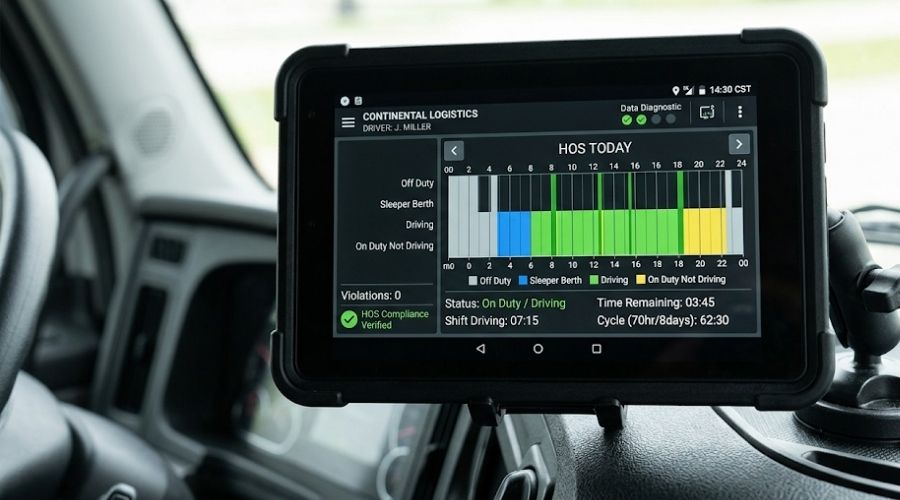
Hours of service violations are among the most frequently documented causes of serious truck crashes, and they are among the most powerful forms of evidence in a resulting injury claim. Federal HOS rules limit truck drivers to 11 hours of driving within a 14-hour on-duty window after 10 consecutive hours off duty. A 30-minute rest break is required after 8 hours of driving. Weekly limits cap on-duty time at 60 hours over 7 days or 70 hours over 8 days. California applies its own intrastate rules for carriers operating exclusively within the state, which in some respects are more stringent than the federal baseline.
Hours of service violations are powerful evidence in accident cases because they prove the company prioritized profits over safety. When a fatigued driver causes a crash, the company shares liability for allowing the violation. Since December 2017, most commercial carriers have been required to use electronic logging devices to automatically record driving time. ELD data under 49 CFR Section 395.8 provides objective evidence of driver on-duty and driving time in the periods leading up to a crash — and that data must be preserved immediately after the accident, before it is overwritten.
Multiple Liable Parties — More Than Just the Driver
One of the most consequential differences between a standard car accident and a truck accident is the number of parties who may share legal responsibility for what happened. In a car accident, the liable party is almost always the other driver. In a truck accident, the driver is often only the starting point.
The trucking company itself carries direct liability through several independent legal theories. Respondeat superior holds an employer responsible for the negligent acts of an employee committed within the scope of employment. Beyond that, California recognizes negligent hiring (failing to verify a driver’s qualifications before putting them behind the wheel), negligent entrustment (allowing a driver to operate a truck they know or should know poses a risk), negligent retention (continuing to employ a driver with known safety violations), and negligent supervision (failing to monitor compliance with federal regulations). These claims frequently expand discovery and damages and can support punitive damages.
The cargo loader may bear liability if improperly secured freight caused or contributed to the crash. Improperly secured cargo can cause loads to shift, leading to rollovers, jackknifes, or cargo spills that create hazardous road conditions. The maintenance provider — whether an in-house shop or a third-party contractor — may be liable if a mechanical failure resulted from deferred or negligent maintenance. The vehicle or component manufacturer may face a product liability claim if a defect in the truck’s braking system, tires, or other components contributed to the crash. Identifying every party with potential liability, rather than stopping at the driver, is one of the most important early steps in a truck accident case.
Commercial Insurance — Larger Policies, More Aggressive Defense
The insurance landscape in a truck accident claim is fundamentally different from a standard car accident. Federal and California law require commercial trucking companies to carry minimum liability insurance of $750,000 for trucks over 10,000 pounds hauling non-hazardous freight. For trucks carrying oil or certain hazardous materials, the minimum increases to $1,000,000 or $5,000,000 depending on the cargo type. These minimums are dramatically higher than California’s standard auto insurance minimums — and the actual policies carried by major trucking companies frequently exceed the legal minimums by a significant margin.
Larger policies mean larger potential recoveries for seriously injured victims. They also mean more aggressive defense. Commercial trucking insurers deploy specialized adjusters and legal teams who handle truck accident claims exclusively. They understand the regulations, know where evidence can be challenged, and have established strategies for limiting payouts. Going up against that infrastructure without experienced legal representation puts an injured victim at a severe disadvantage from the first phone call.
Critical Evidence — and Why It Disappears Fast
Truck accidents generate categories of evidence that simply do not exist in standard car accident cases — and that evidence is time-sensitive in ways that make the hours immediately after a crash critical. ECM data, ELD records, dashcam footage, telematics, dispatch communications, driver qualification files, maintenance records, and post-crash inspection results must all be preserved. A preservation letter should be served within days of the incident because commercial electronic data is frequently overwritten on short cycles.
The black box, or event data recorder, captures speed, braking force, engine RPM, and other performance data in the seconds before impact. ELD records show the driver’s complete hours-of-service history in the days leading up to the crash, which is the primary evidence for a fatigue-based claim. Dispatch records and communications can reveal whether the company pressured the driver to exceed legal limits or ignore safety protocols. Maintenance logs can establish whether known mechanical defects were deferred rather than repaired. Each of these evidence categories requires a formal preservation demand — known as a spoliation letter — sent to the trucking company as soon as possible after the crash. An attorney should send that letter on the first day they are involved in the case.
Negligence Per Se and Punitive Damages
When a trucking company or driver violates a specific FMCSA regulation and that violation directly causes the crash, California law may treat the violation as negligence per se — meaning the violation itself proves negligence without requiring additional evidence about the defendant’s general conduct. Hours of service violations that contribute to fatigue-related crashes are classic examples of negligence per se treatment. This doctrine significantly strengthens liability in cases where clear regulatory violations can be documented.
FMCSA violations can support punitive damage claims when they demonstrate willful disregard for safety. Companies that systematically violate regulations or pressure drivers to break rules may face punitive damages beyond compensation for injuries. California Civil Code Section 3294 allows punitive damages when a defendant’s conduct is found to be malicious, oppressive, or fraudulent. In truck accident cases involving documented patterns of regulatory violation, this is a meaningful avenue that does not exist in standard car accident claims — and one that can substantially increase total compensation.
What to Do After a Truck Accident in California
Call 911 and remain at the scene. Seek medical attention immediately, even if your injuries initially seem manageable — the adrenaline response after a serious collision frequently masks pain and injury severity. Photograph everything you can access safely: the truck, the truck’s license plate and DOT number displayed on the cab, the trailer identification, the cargo if visible, the road conditions, and your visible injuries. Note the trucking company name and any markings on the trailer. If there are witnesses, collect their contact information before they leave.
Do not give a recorded statement to the trucking company’s insurer before speaking with an attorney. Commercial truck insurers are experienced at using early recorded statements to establish facts that limit their liability exposure — and what you say in the first call can affect the entire trajectory of your claim. Contact an attorney immediately so that a preservation demand can be sent to the trucking company before critical electronic evidence is overwritten. At Oracle Law Firm, our abogados de accidentes de camiones begin that evidence preservation process from the moment you contact us.
Preguntas frecuentes
Why are truck accident claims more complex than car accident claims in California?
What is an hours of service violation and how does it affect my claim?
Can I sue the trucking company directly, not just the driver?
How much insurance do trucking companies carry in California?
What evidence needs to be preserved immediately after a truck accident?
Injured in a Truck Accident? Talk to an Attorney Before the Evidence Disappears
Every day that passes after a truck accident is a day critical electronic evidence moves closer to being overwritten. Oracle Law Firm | Accident & Injury Attorneys handles truck accident claims throughout Southern California with no upfront fees — you only pay if we recover compensation for you. Contacta hoy mismo con nuestro equipo. so we can begin preserving evidence and identifying every party responsible for your injuries.