Bicycle accident claims in California cover far more than most injured cyclists realize. When a crash happens, the immediate focus is naturally on injuries and recovery — not on understanding what the law actually entitles you to. The result is that many cyclists either accept a settlement that falls significantly short of what their claim is worth or miss components of compensation entirely because they are unaware of how to include them. This guide covers what California law allows cyclists to claim, how each component gets calculated, and what affects the final settlement value.
What California Bicycle Accident Claims Actually Cover
California personal injury law divides bicycle accident compensation into two primary categories: economic damages and non-economic damages. Economic damages cover everything with a measurable dollar value — the bills, the lost income, the costs you can document with receipts. Non-economic damages cover the human cost of the crash — the pain, the emotional toll, and the impact on your life that cannot be captured on a receipt but is just as real and just as recoverable under California law.
Understanding both categories — and making sure your claim includes all of them — is what separates a fair settlement from one that leaves money on the table. According to the National Highway Traffic Safety Administration, cyclists are among the most vulnerable road users, and the injuries they sustain in crashes are frequently more severe than those in equivalent car accidents. That severity is exactly why fully documenting every component of a claim matters so much.
Medical Expenses — Past and Future
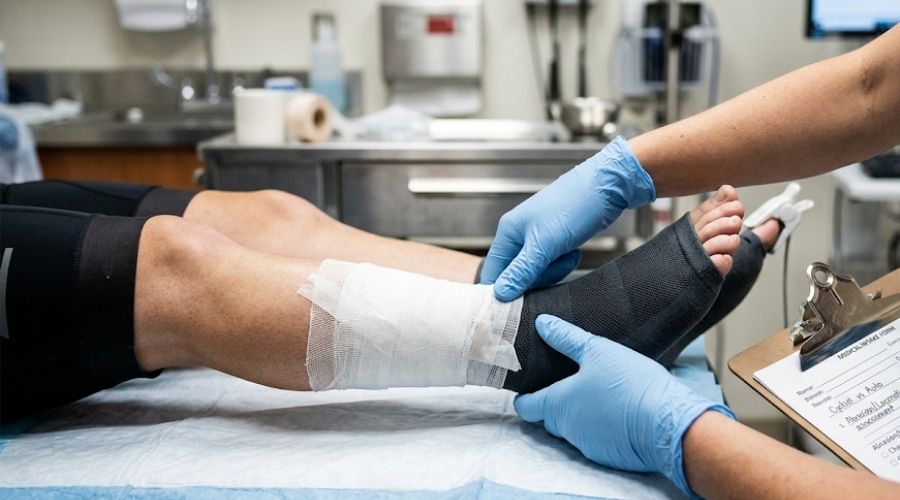
Medical expenses are typically the largest single component of a bicycle accident claim, and they extend well beyond the initial emergency room visit. Every bill connected to treating the injuries from your crash is recoverable: emergency care, hospitalization, surgeries, specialist consultations, physical therapy, prescription medications, medical equipment, and transportation to and from appointments. Research from Stanford Health Care indicates bicycle crashes are among the top causes of injury seen in trauma services, frequently requiring extensive rehabilitation and ongoing treatment — all of which belongs in your claim.
Future medical expenses are equally recoverable but require careful documentation. If your treating physician projects that you will need ongoing care — additional surgeries, continued physical therapy, specialist follow-ups, or long-term medication — those projected costs must be documented through medical expert opinion to carry weight in settlement negotiations. Accepting a settlement before the full scope of your medical needs is understood is one of the most common and costly mistakes in bicycle accident claims, since a signed settlement typically prevents you from seeking additional compensation even if your condition worsens later.
Lost Wages and Diminished Earning Capacity
If your injuries kept you from working — whether for days, weeks, or months — every dollar of missed income is recoverable. This applies to salaried employees, hourly workers, freelancers, gig workers, and self-employed cyclists alike. Pay stubs, employer letters, tax returns, and invoices all serve as documentation. The claim should account for every day of work missed from the date of the accident through the date of settlement or trial, not just the first few days.
In more serious cases, the financial impact extends beyond missed time and into long-term earning capacity. If your injuries prevent you from returning to your prior occupation, limit the number of hours you can work, or reduce your ability to perform the same tasks as before, California law allows you to claim compensation for that diminished future earning capacity. Establishing this component of a claim typically requires expert economic analysis and vocational assessment — both of which an experienced bicycle accident attorney will know how to obtain and present effectively.
Property Damage — Including Your Bicycle and Gear
Property damage in bicycle accident claims in California goes beyond just the frame of the bike. You are entitled to recover the cost to repair or replace your bicycle, your helmet, cycling shoes, clothing, bike computer, lights, panniers, and any other personal equipment that was damaged or destroyed in the crash. Keep photographs of all damaged property and obtain repair estimates or replacement quotes from a reputable bike shop as close to the accident date as possible.
If the bicycle cannot be repaired to its pre-accident condition, replacement value — not depreciated value — is the appropriate measure of damages. Insurance companies sometimes push for a depreciated value calculation on older bikes; an attorney familiar with property damage claims can push back on that and establish fair market replacement value instead.

Pain and Suffering — and How the Multiplier Works
Pain and suffering is typically the most significant non-economic component of a accidente de bicicleta claim, and it is also the component insurance companies work hardest to minimize. California does not cap pain and suffering damages in standard vehicle accident cases, which means there is no arbitrary ceiling on what this portion of a claim can be worth.
The most widely used calculation method is the multiplier approach. Total economic damages — medical bills, lost wages, property damage — are multiplied by a factor between 1.5 and 5, depending on how severe and lasting the physical and emotional impact of the injuries has been. Minor injuries with a short recovery period justify lower multipliers. Severe injuries, permanent disability, chronic pain, or injuries that fundamentally alter a cyclist’s daily life justify multipliers at the higher end of that range. Keeping a detailed personal journal throughout recovery — documenting daily pain levels, physical limitations, and the activities you can no longer do — is one of the most effective ways to support a higher multiplier when the time comes to negotiate.
Emotional Distress and Loss of Enjoyment of Life
Non-economic damages extend beyond physical pain. Emotional distress — the anxiety, fear, depression, and psychological trauma that follow a serious crash — is a separately recoverable component of a California bicycle accident claim. So is loss of enjoyment of life: the activities you can no longer participate in, the hobbies you had to abandon, and the quality of life you had before the accident that the injury has taken away.
These damages are harder to quantify than a medical bill, but they are genuine and legally recognized losses. Consistent documentation — through journal entries, medical records noting psychological symptoms, and testimony from family members or friends about observable changes in your quality of life — gives these components the evidentiary foundation they need to be taken seriously in settlement negotiations.
What Settlement Ranges Actually Look Like in California
Settlement values in California bicycle accident claims vary substantially based on injury severity, liability strength, and how completely damages are documented. As a general framework based on case data, minor injuries such as road rash, soft tissue damage, or minor lacerations typically produce settlements in the $10,000 to $50,000 range. Moderate injuries including fractures, dislocations, or concussions generally settle between $50,000 and $200,000. Severe injuries involving lesión cerebral traumática, daño a la médula espinal, or multiple serious fractures regularly exceed $200,000, and catastrophic injury or wrongful death cases can reach into the millions.
These figures are starting points for understanding the landscape, not guarantees. The actual value of any specific claim depends on the quality of the liability evidence, the completeness of the damages documentation, the available insurance coverage, and whether future costs are properly included. A claim for a moderate fracture injury that is poorly documented and accepted before treatment is complete may settle for far less than the range above suggests, while the same injury handled with thorough documentation and experienced legal representation may settle at or above it.
Bicycle Accident Claims California: How Comparative Fault Affects Your Recovery
California’s pure comparative negligence rule means your total compensation is reduced by your assigned percentage of fault — not eliminated. A cyclist found 25% at fault on a claim valued at $100,000 still recovers $75,000. This is a genuinely protective rule for injured cyclists, but it is also the mechanism insurance companies most aggressively exploit to reduce payouts.
Adjusters handling bicycle accident claims commonly argue that cyclists contributed to the crash by riding outside the bike lane, failing to use hand signals, traveling too fast, wearing dark clothing, or being distracted. Some of these arguments have merit in specific factual circumstances; many are overstated. The defense must prove a causal connection between the cyclist’s conduct and the crash itself — not simply identify that the cyclist made choices the insurer finds useful. Having an attorney evaluate and push back on comparative fault arguments before they are baked into a settlement offer is one of the highest-value interventions in a bicycle accident claim.
The Deadline You Cannot Miss
California’s statute of limitations for personal injury claims is two years from the date of the accident. Missing this deadline means permanently losing the right to pursue any compensation, regardless of how strong the case is. For claims involving a government entity — a road defect maintained by a city or county, a malfunctioning traffic signal, or a poorly designed bike lane — the deadline is far shorter: six months to file a Government Tort Claim before any lawsuit can even be initiated. If there is any possibility that a public agency’s negligence contributed to your crash, that six-month clock is already running from the day of the accident.
En Oracle Law Firm, nuestros bicycle accident attorneys handle claims throughout Southern California and identify every deadline that applies to your specific situation from the first consultation. We also help cyclists understand the full scope of what their claim is worth before they respond to any offer from an insurer.
Preguntas frecuentes
What is the average bicycle accident settlement in California?
Can I include my bicycle and gear in a California bicycle accident claim?
How is pain and suffering calculated in a California bicycle accident case?
What is the deadline to file a bicycle accident lawsuit in California?
Can I still recover compensation if I was partly at fault for the bicycle accident?
Not Sure What Your Bicycle Accident Claim Is Worth? Talk to an Attorney
Most cyclists underestimate what their claim is worth — and insurance companies count on that. Oracle Law Firm | Accident & Injury Attorneys offers free, confidential consultations across Southern California with no upfront fees. You only pay if we recover compensation for you. Contacta hoy mismo con nuestro equipo. to find out the full value of your claim before you respond to any offer.