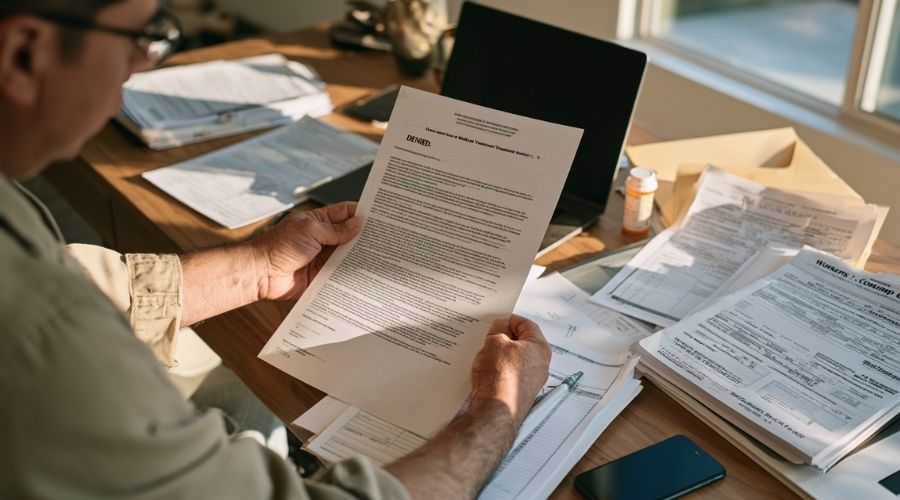
When the insurance company denied your claim in California, the letter that arrived probably felt like the final word. It is not. A denial is the opening move in a negotiation that most insurance companies expect the claimant to lose by walking away. California law gives injured claimants specific rights to challenge denials — through internal appeals, regulatory complaints, and litigation — and many denials that people accept as final are reversed when those rights are exercised. Understanding why your claim was denied, whether the denial is legitimate or a pressure tactic, and what each available path forward looks like is the information you need before you respond to anyone.
Insurance Company Denied My Claim California: What the Letter Actually Means
California law requires insurers to provide written explanations for claim denials that cite the specific policy provisions being relied on. Under California Insurance Code Section 790.03 y el California Fair Claims Settlement Practices Regulations, insurers must respond to policyholder communications within 15 days, provide reasonable plain-language explanations for denials, and participate in the internal appeals process in good faith. A denial letter that does not meet these requirements may itself constitute a regulatory violation.
The first thing to do after receiving a denial is read the letter in full — not to accept it, but to understand it. The letter contains the reason for the denial, the policy language the insurer is citing, and the deadline to appeal. That information controls everything that follows. Before calling the insurer, pull your actual insurance policy and compare what the denial letter says against what your coverage terms actually state. Insurers frequently apply exclusion language more broadly than the policy supports, and the gap between what the denial claims and what the policy actually says is often where a successful challenge begins.
The 9 Most Common Reasons Insurance Companies Deny Claims in California
Understanding which category your denial falls into determines the most effective response. Insurance companies deny claims for specific, documented reasons, and California law requires them to state exactly why in writing. Some of these reasons are legitimate under the policy; many are not.
Coverage disputes and policy exclusions. The insurer argues that your specific accident or injury falls outside what the policy covers — a particular type of collision, a use-case exclusion for rideshare driving, or an activity-based exclusion. These denials require a careful reading of whether the exclusion cited actually applies to your specific facts, not just whether an exclusion exists in general.
Disputed fault or liability. The insurer concludes that their policyholder was not at fault, or that you were primarily responsible for the crash. Insurers may try to exploit California’s comparative negligence system by assigning you an unfairly high percentage of blame. Even when fault is partially shared, California’s pure comparative negligence rule means you can still recover compensation reduced by your percentage — which is why inflated fault assignments are worth challenging directly. Our post on how comparative negligence affects your payout in California explains this in detail.
Late reporting. The insurer claims you missed their deadline to report the accident or submit claim paperwork. Many late-reporting denials are challengeable — particularly when the delay was caused by hospitalization, incapacity, or other circumstances outside your control. If your claim was denied for late reporting, documenting the reason for the delay and requesting reconsideration with supporting evidence is the immediate step.
Pre-existing condition arguments. The insurer claims your injuries existed before the accident and are not compensable. California applies a “take you as they find you” standard — if the accident aggravated, accelerated, or worsened a pre-existing condition, that aggravation is fully compensable. A pre-existing condition denial requires a medical expert response that distinguishes the baseline condition from the new injury caused by the crash.
Insufficient medical documentation. Documentation gaps are a common denial basis. Insurers deny claims when the medical evidence does not establish a clear connection between the accident and the injuries claimed. This type of denial often arises when treatment was delayed, inconsistent, or when medical records do not specifically connect the diagnosis to the accident event. Consistent, prompt medical care and records that directly link symptoms to the crash date are the most effective prevention — and the most effective response when the denial has already arrived.
Lapsed or invalid coverage. The insurer claims the policy was inactive on the date of the accident. If your policy was canceled without proper notice, or if the cancellation was procedurally defective under California law, the denial may be challengeable on those grounds alone.
Disputed medical necessity. The insurer argues that the treatment you received was not medically necessary for your injuries. These denials are particularly common in cases involving specialist referrals, surgical recommendations, and extended physical therapy. A written rebuttal from your treating physician, supported by medical literature where applicable, is the standard response.
Missing or incomplete documentation. Insurers may ask for excessive documentation, hoping you will miss a step. Documentation demands must be reasonable under California law. If the insurer is denying on grounds of missing paperwork that was never properly requested or that is not actually required by the policy, that procedural position can be challenged through the appeal process.
Allegations of misrepresentation. The insurer claims you provided false or misleading information on the claim or policy application. These are the most serious denial grounds and require careful legal analysis — but they are also frequently overstated, applied to minor inconsistencies that do not actually constitute material misrepresentation under California law.
First-Party vs. Third-Party Denials — Why the Distinction Matters
The most important legal distinction in a California claim denial is whether it comes from your own insurer or from the at-fault driver’s insurer — because the remedies available are different.
A first-party denial is from your own insurer — your uninsured motorist coverage, MedPay, or collision coverage. California’s full bad faith doctrine applies, and punitive damages are available. When your own insurer denies a valid claim without reasonable basis, they are violating their contractual duty to you — the person who paid their premiums. That breach can support a bad faith lawsuit that recovers not just the denied benefits but also the consequential damages and, in egregious cases, punitive damages.
A third-party denial is from the at-fault driver’s insurer. No direct bad faith cause of action exists against a third-party insurer. However, a third-party denial does not end your options — it typically means your attorney files a personal injury lawsuit directly against the at-fault driver, which compels the insurer to defend the case and re-engage with the liability question through litigation rather than unilateral denial. For hit-and-run situations where the at-fault driver is unknown, your own uninsured motorist coverage becomes the primary path — see our guide on Accidentes de atropello y fuga en el condado de Orange for how UM claims work after a denial.
California Bad Faith Insurance Law — When a Denial Crosses the Line
California has some of the strongest bad faith insurance protections in the country. Insurance bad faith occurs when an insurer unreasonably denies, delays, or underpays a valid claim. California insurers owe a covenant of good faith and fair dealing. They must look for reasons to pay valid claims, not excuses to deny them.
Bajo California Insurance Code Section 790.03 and the foundational case of Comunale v. Traders and General Insurance Co., specific insurer conduct constitutes bad faith: denying valid claims without a reasonable investigation, misusing policy exclusions to justify denials, rescinding coverage after a loss based on minor application errors, and ignoring evidence that supports payment. When bad faith is established, the damages available go beyond the policy limits — consequential damages, emotional distress damages, attorney fees, and punitive damages are all potentially available against an insurer found to have acted in bad faith toward its own policyholder.
Step 1 — Read the Denial Letter and Note the Appeal Deadline
Every denial letter contains an appeal deadline. Missing it can waive your right to the internal appeal process entirely. Read the letter carefully, note the deadline, and contact an attorney before that date passes — not after. The denial letter also identifies the specific policy language the insurer is relying on, which is the starting point for any challenge. Do not call the insurer to discuss the denial before speaking with an attorney — anything you say in that conversation can be used to strengthen their position.

Step 2 — File a Formal Written Appeal
A formal appeal to the insurance company is the most common first step. Most insurance policies include an internal dispute resolution process, and California law requires insurers to participate in that process in good faith. Your appeal letter should cite the specific policy language that covers your claim, attach all supporting documentation including medical records and evidence of the accident, directly address the denial reason, and state clearly why the denial is not justified under the policy terms.
This is where an attorney’s involvement makes the most measurable difference. Attorney involvement alone often prompts reconsideration of a denial that a self-represented claimant would have accepted. The insurer knows that an attorney will escalate through the regulatory and litigation pathways if the appeal is wrongly denied — which changes how seriously the appeal is reviewed internally.
Step 3 — File a California Department of Insurance Complaint
If the internal appeal does not resolve the denial, filing a complaint with the Departamento de Seguros de California is the next step. Filing is free and creates an official regulatory record. A CDI complaint triggers an inquiry into the insurer’s handling of your claim, creates a documented record that the insurer’s conduct was investigated, places regulatory pressure on the insurer — particularly carriers with prior CDI complaints — and strengthens a subsequent bad faith lawsuit.
A CDI complaint does not directly force the insurer to pay your claim, but it is a meaningful escalation that carriers take seriously. Insurers with patterns of CDI complaints face regulatory scrutiny that creates institutional pressure to resolve disputed claims rather than face ongoing investigation. The complaint record also becomes relevant evidence if the case eventually proceeds to a bad faith lawsuit.
Step 4 — File a Personal Injury Lawsuit
When administrative remedies are exhausted or when a third-party denial is involved, the most direct path to recovery is filing a personal injury lawsuit against the at-fault party. A lawsuit does several things simultaneously: it compels the insurer to defend the case through their own legal team, it triggers the formal discovery process where evidence must be exchanged, and it signals that the denial will not be accepted without litigation — which changes the insurer’s calculus on settlement.
California’s two-year statute of limitations under Artículo 335.1 del Código de Procedimiento Civil governs the deadline to file that lawsuit — and it runs from the date of the accident regardless of how long the denial and appeal process takes. Allowing the negotiation and appeal timeline to run past the statute of limitations is one of the most avoidable and consequential mistakes after a claim denial. For a complete guide to all applicable California filing deadlines, see our post on how long you have to file a car accident claim in California.

What to Do in the First 48 Hours After a Denial
The first 48 hours after a denial letter arrives are the most consequential. Read the letter in full and identify the stated reason, the policy language cited, and the appeal deadline. Pull your insurance policy and compare the denial reason against your actual coverage terms. Do not call the insurer. Gather all supporting documentation — medical records, accident photographs, the police report, and any prior correspondence with the insurer. Contact a personal injury attorney immediately.
The denial is not the end. It is the moment the claim moves from a negotiation into a dispute that California law is specifically designed to resolve in favor of claimants with valid claims and the legal support to pursue them. At Oracle Law Firm, our abogados de lesiones personales evaluate denied claims throughout Southern California, identify whether the denial is legitimate or a pressure tactic, and pursue every available avenue to overturn wrongful denials — with no upfront fees and no obligation.
Preguntas frecuentes
Is a denied insurance claim in California final?
What are the most common reasons insurance companies deny claims in California?
What is insurance bad faith in California and when does it apply?
How do I file a complaint with the California Department of Insurance?
What should I do in the first 48 hours after receiving a denial letter?
Claim Denied? Talk to an Attorney Before You Accept It
A denial letter is designed to look final. It almost never is. Oracle Law Firm | Accident & Injury Attorneys evaluates denied claims throughout Southern California — identifying whether the denial is legitimate, which appeal pathway is strongest, and whether bad faith damages apply. No upfront fees, no obligation. Contacta hoy mismo con nuestro equipo. before your appeal deadline passes.