Huntington Beach accident claims often come from Pacific Coast Highway, where beach traffic, pedestrians, cyclists, and out-of-town drivers share a state highway. California uses pure comparative fault, so being partly at fault does not end your claim. Civil claims generally run two years, but a claim involving a government agency has a much shorter deadline.
Summer on Pacific Coast Highway is its own kind of driving. Cars are slowing for parking they will not find. People crossing toward the sand with a cooler in each hand. Cyclists in the corridor. Someone from out of state is hunting for Main Street while doing forty in a lane that is about to end.
If a crash on that road is why you are reading this, the situation is probably worse than the vehicle damage suggests. You may be dealing with pain, a car you need for work, and an insurance adjuster who already sounds like your friend.
Huntington Beach accident claims are shaped by the specific character of this stretch of coast and by insurance companies that handle these cases in volume every summer. Knowing the pattern is how you avoid the parts that go badly.
Here’s what really matters after a crash in Huntington Beach. Our car accident attorneys handle claims throughout the coastal cities.
What Huntington Beach Accident Claims Usually Involve
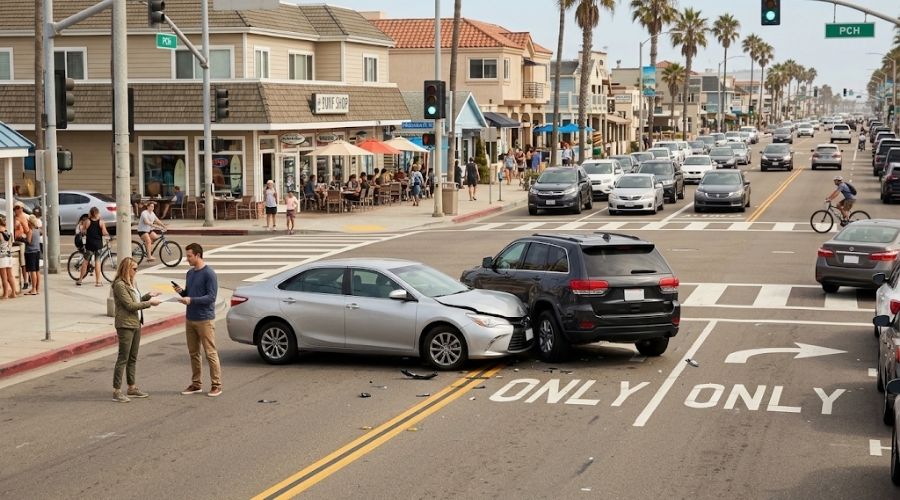
Most claims here come from collisions on or near Pacific Coast Highway, Beach Boulevard, and the surface streets feeding the pier and the beach lots. A claim typically involves the at-fault driver’s liability insurance, your own coverage, and medical treatment that begins before anyone agrees who pays.
Fault is the central fight in almost all of them. Unlike a workers’ comp claim, which pays regardless of blame, a car accident claim requires showing that someone else’s negligence caused your injuries.
That is why the first week matters so much. Evidence about how a crash happened is at its strongest immediately and degrades fast, especially in a city where half the witnesses are on vacation.
Why PCH Behaves Differently From Any Other Road Here
Pacific Coast Highway through Huntington Beach is a state highway that functions as a beach town’s main street. That combination creates conflicts you do not find on ordinary arterials.
Traffic moves at highway speed while pedestrians cross toward the sand, drivers slow abruptly for parking, and cyclists ride the corridor in numbers. The stretch between the Santa Ana River and Sunset Beach is popular with riders and has seen enough serious collisions that Caltrans has been adding bike lanes in both directions as part of its Complete Streets work aimed at reducing deaths on state highways.
Add the seasonal layer. Surf contests, holiday weekends, and events near the pier fill Main Street and push overflow traffic onto residential streets that were not built for it. Downtown nightlife creates its own risks for drivers on the way home.
The practical effect for a claim: many crashes here involve a driver unfamiliar with the road, and unfamiliarity produces the specific errors that follow.
The Crashes Summer Produces
Certain collision types repeat here every season, and knowing which one you were in shapes how the claim gets investigated.
Left turns across traffic are the classic. A driver turns into a beach lot or a side street across oncoming lanes and misjudges the speed of traffic that is moving faster than it looks.
Rear-end chains are next, from stop-and-go beach traffic where one distracted driver compresses four cars. Then there are pedestrian collisions from mid-block crossings and bicycle and e-bike collisions, which have grown as e-bikes have become ordinary transportation in this city.
Two more worth naming. Parking maneuvers, where a driver pulls out of a space or opens a door into a travel or bike lane. And impaired driving after evening events downtown, which tends to produce the most severe injuries.
Fault Is Rarely All or Nothing in California
California follows pure comparative fault. That means if you are found partly responsible for a crash, your recovery is reduced by your percentage of fault rather than eliminated. Even a driver who bears significant blame can still recover something from another at-fault party.
This matters because insurers use partial fault as their main lever. If they can blame you, they reduce what they owe by that amount, and every percentage point is money.
It is also why the recorded statement request arrives so early. A friendly conversation about whether you “might have been going a little fast” or “didn’t see them until the last second” becomes the foundation of a comparative fault argument later.
You are generally not required to give a recorded statement to the other driver’s insurer. Being polite does not require being cooperative with the company whose interests run against yours.
Every percentage of blame they pin on you is money they do not have to pay.
When a Government Agency Is Part of the Problem
Occasionally the road itself is part of what happened. A poorly designed crossing, a signal timing problem, obscured sightlines, missing signage, or a hazardous condition left unaddressed can contribute to a crash.
Because PCH is a state highway, that kind of claim can involve Caltrans, and other roadways may involve the city or the county. These claims can be challenging, but they are especially important in severe cases where the at-fault driver’s coverage is insufficient.
Here is the trap. Claims against public entities in California generally require presenting a written claim within six months, not the two years that apply to ordinary civil claims. Miss that window and the claim is usually gone regardless of how strong it was.
Six months disappears quickly when you are having surgery and fighting with an insurer. If there is any chance a public agency shares responsibility, that possibility needs to be evaluated early rather than late.
What the Other Driver’s Insurer Does in the First Week
The adjuster’s opening move is warmth. A prompt call, sympathy about your week, and an offer to make the process easy. None of that is exactly fake, but the adjuster’s job is to close your claim for as little as possible.
Watch for three specific requests. A recorded statement, before you know it, of the extent of your injuries. A blanket medical authorization, which opens your entire health history so they can attribute your pain to something older. And a hasty settlement offer often arrives before you have had an MRI.
That early offer is the one that costs people the most. Soft tissue injuries and concussion symptoms frequently declare themselves weeks after a crash, and a signed release ends the claim permanently, including for treatment you have not discovered you need.
The counter is unglamorous. Get medical care, follow through on it, keep your own records, and do not sign anything releasing a claim until someone who represents you has read it.
The fastest offer always arrives before you know what is actually wrong with you.
What to Do After a Crash on PCH
Call for a police response and make sure a report is created. Jurisdiction on the coast can vary between Huntington Beach police and the California Highway Patrol, so let dispatch route it and get the report number before you leave.
Photograph more than the damage. Capture the lane configuration, the signals and signs, where each vehicle ended up, skid marks, and the general traffic conditions. In a construction or restriping zone, photograph that too, because the roadway may look different next month.
Collect witness contact information yourself, right there. Witness information is the single most perishable thing at a Huntington Beach crash scene, because the witness helping you today is driving back to Arizona tomorrow.
Then promptly see a doctor, describe every symptom rather than just the worst one, and tell your own insurer about the crash. If your injuries came from a hit-and-run or an uninsured driver, your own uninsured motorist coverage may be the claim that matters, and those claims have notice requirements of their own.
Conclusion
Two takeaways. Pacific Coast Highway concentrates highway speeds, beach crowds, cyclists, and unfamiliar drivers in one corridor, which is why Huntington Beach accident claims so often involve disputed fault. And the deadline that ends the most claims here is not the two-year civil one; it is the six-month window that applies when a public agency may share responsibility.
You do not have to argue with an adjuster while you are still in pain. Oracle Law Firm represents injured people in Huntington Beach and across Orange County, handling personal injury claims from the first call through resolution.
Been in an accident or hurt on the job? You don’t have to navigate insurance companies alone. Oracle Law Firm fights to get you the compensation, control, and clarity you deserve.
Get a Free Consultation or call 888.597.4099.
This article is for general information only and is not legal advice. Every case turns on its own facts, and outcomes depend on the specific circumstances involved. Speak with an attorney about your situation.
Frequently Asked Questions
What should I do immediately after a car accident on PCH?
Get to safety, call the police so they can create a report, and photograph the vehicles, lane configuration, signals, and final resting positions. Collect witness contact information on the spot, since many people on the coast are visitors who will leave the area. Then see a doctor promptly, even if you feel functional.
Can I still recover if I was partly at fault for the crash?
Yes. California follows pure comparative fault, which reduces your recovery by your share of responsibility rather than barring it entirely. This is precisely why insurers work to assign you a percentage of blame early, often through a recorded statement taken before you have all the facts.
Do I have to give the other driver’s insurance company a recorded statement?
Generally no. You have obligations to your insurer under your policy, but you are typically not required to provide a recorded statement to the other driver’s carrier. Those statements are frequently used later to support a comparative fault argument, so it is reasonable to decline until you have spoken with an attorney.
How long do I have to file a claim after a Huntington Beach accident?
California generally allows two years from the date of injury to file a personal injury lawsuit. If a public entity may share responsibility, such as through a dangerous roadway condition on a state highway, a written claim usually must be presented within six months. That shorter deadline is the one people most often miss.
What if the driver who hit me on PCH left the scene or had no insurance?
Uninsured motorist coverage on your auto policy may apply to hit-and-run and uninsured driver crashes. California insurers must offer this coverage, though drivers can decline it in writing, so check your policy. These claims have their own notice requirements, so report the crash to your insurer promptly.