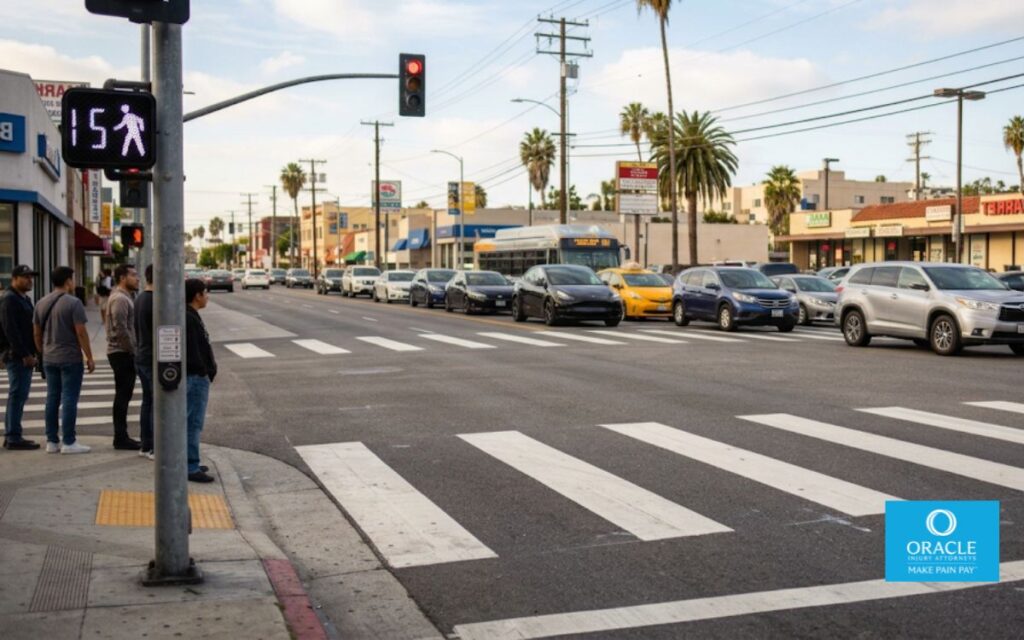
Pedestrian accident fault in California is not as automatic as most people assume. When a driver hits a pedestrian, the instinctive reaction is that the driver bears full responsibility — but California law establishes a shared duty of care, and insurance companies know exactly how to use that against injured pedestrians. Understanding which Vehicle Code sections apply, how recent legal changes affect your rights, and how fault is actually assigned is the most important groundwork you can have before filing a claim. According to the Administración Nacional de Seguridad del Tráfico en las Carreteras, pedestrians account for a disproportionate share of traffic fatalities nationwide — and California’s numbers are among the worst in the country.
California’s Pedestrian Problem — The Numbers Behind the Risk
California’s pedestrian safety record is one of the worst in the country. In 2023, approximately 1,057 pedestrians were struck and killed by vehicles in California, and the state has a pedestrian death rate roughly 24 percent higher than the national average. For every fatality, many more pedestrians are seriously injured — fractures, traumatic brain injuries, spinal damage, and road injuries that require lengthy, expensive recovery. Those numbers make pedestrian claims high-value targets for insurers looking to minimize payouts, which is precisely why understanding fault from a legal standpoint matters so much before you speak to anyone at an insurance company.
The Core Rule — CVC 21950 and the Shared Duty of Care
California Vehicle Code Section 21950 is the foundation of pedestrian right-of-way law in California, and it establishes a balanced duty — not an absolute one in either direction. Under this statute, drivers must yield to pedestrians crossing in any marked or unmarked crosswalk and must exercise due care for pedestrian safety at all times. But the same statute also requires pedestrians not to suddenly leave a curb or step into the path of a vehicle that is close enough to create an immediate hazard.
Critically, even if a pedestrian crosses unlawfully or enters the street improperly, Vehicle Code 21950(d) clearly states that drivers must still continually exercise reasonable care to ensure the pedestrian’s safety. This provision matters enormously in real claims: a driver cannot simply point to a pedestrian’s crossing behavior to escape all responsibility. The driver’s own conduct — their speed, attention level, and reaction — remains subject to scrutiny regardless of what the pedestrian was doing.
Marked Crosswalks, Unmarked Crosswalks, and What the Difference Actually Means
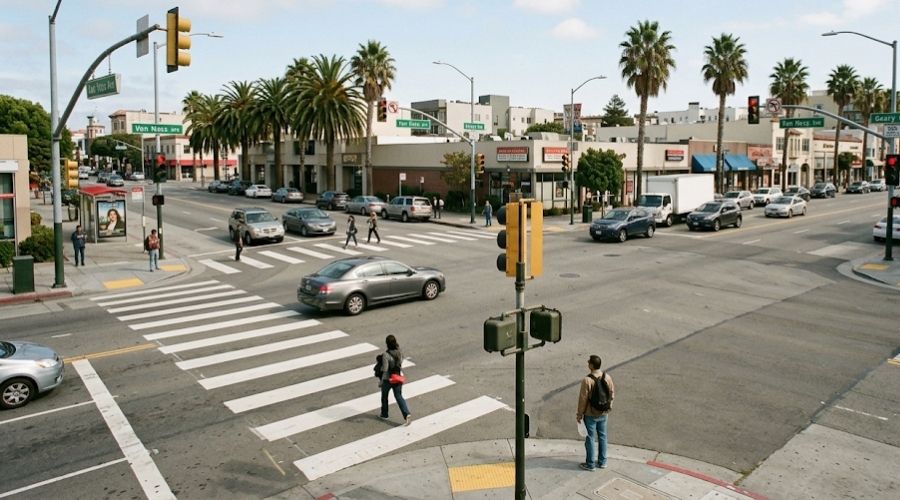
One of the most consequential misunderstandings about California pedestrian law involves crosswalk protection. Many pedestrians — and many drivers — believe that legal crosswalk protection only applies where painted lines are visible. Under California Vehicle Code Section 21950, an unmarked crosswalk still exists legally at most intersections, even if no lines are drawn, and drivers must yield to pedestrians in both marked and unmarked crosswalks. The absence of painted lines does not reduce a driver’s legal duty to yield or remove a pedestrian’s right to cross.
This means that a pedestrian hit while crossing at an intersection — even one with no painted crosswalk — retains the legal protection of crosswalk law as long as they were crossing within the intersection boundaries and not creating an immediate hazard. Insurance companies frequently attempt to argue otherwise, suggesting that the lack of markings implies a lack of protection. That argument does not hold up under California law, and an experienced attorney will challenge it directly.
Signalized Intersections — When the Signal Defines Fault
At intersections controlled by traffic signals, the pedestrian signal itself becomes one of the most important fault determinants. When you cross at a signalized intersection with a pedestrian walk signal, you hold the right of way under CVC 21950, and any driver who fails to yield is in violation of the law. A driver who hits you while you have a valid walk signal faces a strong liability position — the statutory violation alone is significant evidence of negligence.
The flashing countdown signal creates a more nuanced scenario. A pedestrian who is already in the crosswalk when the signal begins to flash retains the right to complete their crossing. A pedestrian who steps off the curb after the steady “Don’t Walk” signal has activated, however, loses the signal protection — a fact insurers frequently use to argue shared fault. The critical distinction is whether the pedestrian had already begun crossing before the signal changed, not simply whether the signal was flashing when the impact occurred.
The Freedom to Walk Act — What Changed in 2023 and Why It Matters for Claims
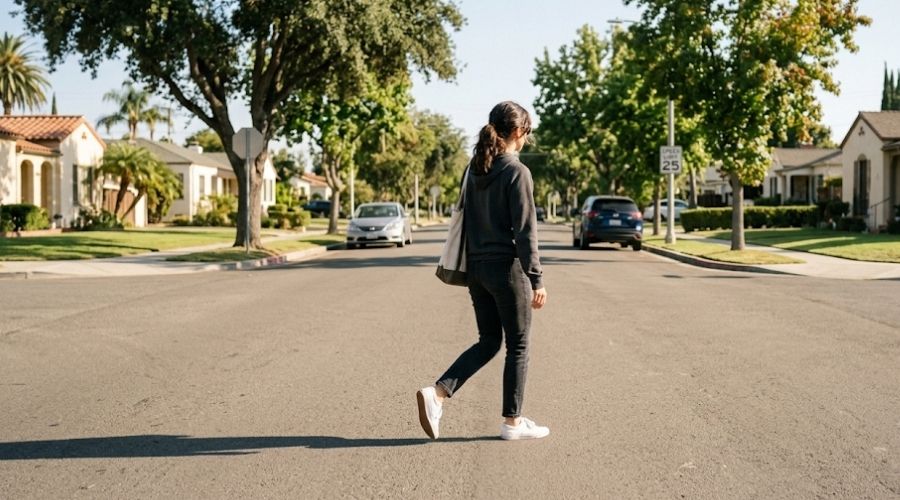
Assembly Bill 2147, known as the Freedom to Walk Act, took effect on January 1, 2023, and changed how jaywalking is enforced across California. The law allows pedestrians to cross the street outside of designated crosswalks when it is reasonably safe to do so, meaning they will not be cited simply for crossing mid-block. Officers may only issue a citation if a pedestrian creates an immediate hazard or risk of collision.
What the Freedom to Walk Act did not change is civil liability. The amendment to the infraction system did not alter civil liability rules. If a pedestrian crossing outside a crosswalk causes an accident, they can still be held responsible or found contributorily negligent in personal injury claims. The practical effect for injured pedestrians is significant: crossing mid-block safely is no longer a citable offense, which removes one tool insurers previously used to paint pedestrians as law-breakers. But it does not mean mid-block crossings carry zero fault risk — the circumstances of the specific crossing still matter in a comparative fault analysis.
The Daylighting Law — A New Protection at Crosswalk Approaches
A more recent development that directly affects pedestrian safety — and potentially liability — is Assembly Bill 413, California’s daylighting law, which took effect January 1, 2025. This law prohibits parking within a specific distance of crosswalk approaches to keep sightlines clear, and these rules apply even without red curb paint or signs after the effective date.
The significance for injury claims is direct: parked vehicles obstructing the line of sight between a driver and a crossing pedestrian are a documented contributing factor in crosswalk crashes. When a parked vehicle in violation of AB 413 blocked a driver’s view of you in the crosswalk, that violation becomes part of the liability picture — potentially implicating not just the driver who struck you but the vehicle owner who was illegally parked in a daylighting zone.
Pedestrian Accident Fault in California — How Comparative Negligence Works
Pedestrian accident fault in California is governed by the state’s pure comparative negligence system, which allows both drivers and pedestrians to share responsibility, with compensation reduced proportionally to each party’s assigned percentage. A pedestrian facing $100,000 in medical expenses and lost wages who is found 20% at fault — for being distracted by a phone and stepping off the curb while a flashing countdown was active — recovers $80,000 rather than the full amount. The system is genuinely protective: it never eliminates recovery entirely based on shared fault, which means even a pedestrian who crossed against a signal or mid-block can still recover significant compensation if the driver was primarily responsible.
Insurance companies frequently leverage Vehicle Code provisions to assign higher fault percentages to pedestrians, thereby reducing settlement payouts for medical expenses and lost wages. The most common arguments involve signal violations, distracted walking, dark clothing at night, or crossing at a location other than a designated crosswalk. Some of these arguments have merit depending on the facts; many are overstated pressure tactics. The burden remains on the defense to prove that a specific pedestrian action directly contributed to the collision, not simply that the pedestrian could have made different choices.
When Drivers Bear Fault Even When Pedestrians Weren’t in a Crosswalk
Bajo CVC 21954, pedestrians crossing outside a marked or unmarked intersection crosswalk are required to yield to vehicles. But even where that requirement applies, a driver who was speeding, distracted, driving impaired, or otherwise operating negligently can still bear significant or even primary fault for the collision. Even mid-block scenarios where a driver was speeding and ran a stop sign — with the pedestrian found 30% at fault for crossing outside a crosswalk — still left the pedestrian entitled to recover 70% of their damages.
The practical takeaway is that the location of the crossing is one factor in fault analysis, not the whole picture. A driver’s own conduct is always relevant — their speed, their attention, whether they had time to react — and those factors can override a pedestrian’s crossing location in the overall fault calculation.
What to Do After Being Hit by a Car
Call 911 and remain at the scene until police arrive and prepare a report. Seek medical attention immediately, even if you feel relatively fine — head injuries, internal bleeding, and soft tissue trauma frequently do not produce obvious symptoms in the first hours after impact. Photograph the accident scene thoroughly: the vehicle’s position, crosswalk markings or their absence, traffic signals, skid marks, and your visible injuries. Collect contact information from any witnesses before they leave.
Avoid discussing fault with the driver at the scene, and do not give a recorded statement to any insurance company before speaking with an attorney. The first recorded statement you give to an adjuster is one of the most consequential moments in a pedestrian claim — and it is also the moment you are most likely to be caught off-guard. Our personal injury attorneys at Oracle Law Firm represent injured pedestrians throughout Southern California and can take over all communication with the insurer from the moment you contact us.
Government Entity Claims — The Six-Month Deadline
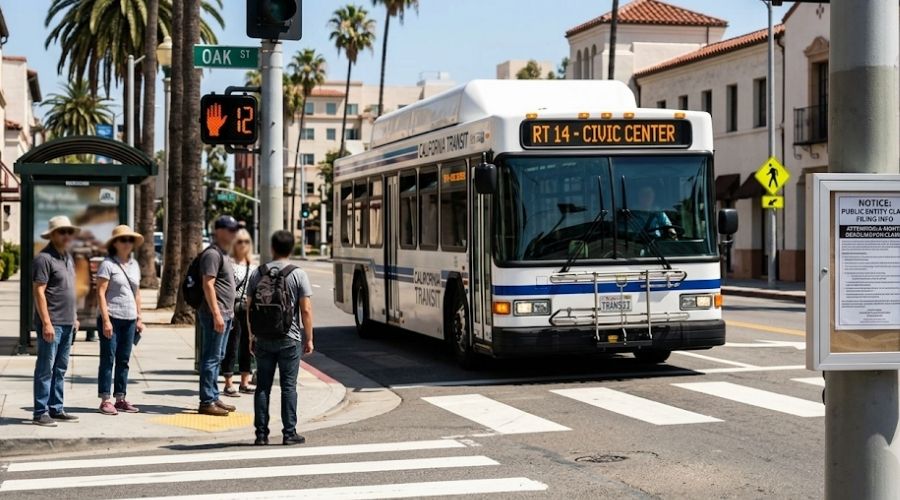
If your accident involved a government vehicle — a city bus, a county maintenance truck, a state vehicle — or if a dangerous road condition maintained by a public agency contributed to the crash, the standard two-year personal injury filing deadline does not apply. If a government vehicle was involved or a public agency is responsible for the hazard, you must submit a formal administrative claim within six months before initiating a lawsuit. Missing this deadline means losing that avenue of compensation entirely. If there is any chance a government entity is involved in your case, this is a deadline that needs to be identified and tracked from day one.
Preguntas frecuentes
Is a driver always at fault when they hit a pedestrian in California?
Do pedestrians have the right of way in unmarked crosswalks in California?
Can I still recover compensation if I was jaywalking when I was hit?
What is the daylighting law and how does it affect pedestrian safety in California?
What should I do immediately after being hit by a car as a pedestrian?
Hit by a Car in California? Talk to an Attorney — No Cost, No Obligation
Pedestrian injury claims move fast, and the steps you take in the first hours and days matter significantly. Oracle Law Firm | Accident & Injury Attorneys represents injured pedestrians throughout Southern California with no upfront fees — you only pay if we recover compensation for you. Contacta hoy mismo con nuestro equipo. before you respond to a single question from an insurance adjuster.