Can you be fired for filing workers’ comp in California? No — and the law is unambiguous on this point. California Labor Code Section 132a makes it a criminal misdemeanor for any employer to fire, threaten, demote, or otherwise punish an employee for filing or intending to file a workers’ compensation claim. The protection is one of the strongest anti-retaliation statutes in the country.
Yet thousands of California workers are illegally fired after filing workers’ comp claims every year, and most of them do not know what their rights are, what remedies are available, or how long they have to act before those remedies disappear. This guide covers every protection the law gives you and every deadline that controls whether you can use it.
Can I Be Fired for Filing Workers Comp in California: What the Law Actually Says
Sección 132a del Código Laboral de California is the foundational statute. It prohibits any employer from discharging, threatening to discharge, or in any manner discriminating against an employee because that employee filed or made known an intention to file a workers’ compensation claim, received a workers’ compensation award or settlement, or testified or is about to testify in another worker’s compensation proceeding.
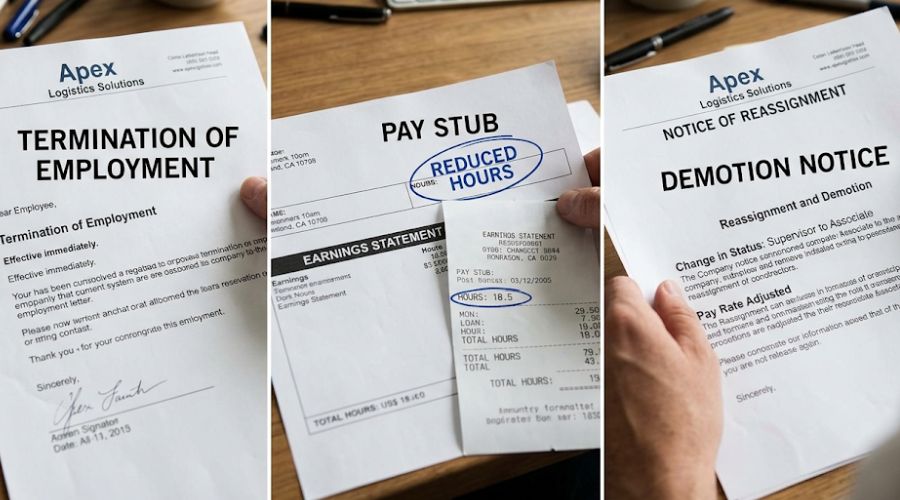
The prohibition covers the full spectrum of adverse employment action — not just termination, but demotions, pay cuts, hour reductions, schedule changes, and any other adverse treatment connected to the workers’ comp filing.
The protection starts before the claim is even filed. Telling your supervisor that you intend to file a workers’ comp claim is a protected activity under Section 132a. Requesting a DWC-1 claim form signals intent — and a termination days after that request raises the same legal problem as a termination after the claim is formally filed.
Retaliating against a worker for supporting a coworker’s workers’ comp claim is also prohibited. According to the División de Compensación para Trabajadores de California, Labor Code Section 132a is one of the most powerful anti-retaliation tools in the California workers’ compensation system — and its violation is both a civil remedy and a criminal misdemeanor offense.
SB 497 — The 90-Day Presumption That Changed Everything
Before Senate Bill 497 took effect on January 1, 2024, proving workers’ comp retaliation required the employee to demonstrate that the workers’ comp filing was the reason for the adverse action — a burden that was difficult to meet when employers could point to any alternative explanation. SB 497 fundamentally changed that dynamic by extending the rebuttable presumption of retaliation to workers’ compensation cases.
Under SB 497, if an employer takes any adverse action against an employee within 90 days of that employer learning about the workers’ compensation claim, the law presumes the action was retaliatory. The burden shifts entirely to the employer — they must prove the adverse action had a legitimate, non-retaliatory reason that existed independently of the workers’ comp filing.
A 2025 California appellate decision further tightened this framework by establishing that employers can no longer claim “administrative error” as a defense for firing an injured worker if they failed to follow their own written HR policies. The combination of SB 497’s presumption and the eroding “innocent mistake” defense has made workers’ comp retaliation cases significantly stronger for employees than they were before 2024.
What Counts as Retaliation — More Than Just Being Fired
Workers’ comp retaliation under California law is not limited to outright termination. Any adverse employment action taken because of a workers’ comp filing can constitute retaliation under Section 132a. Demotion to a lower-paying position or reduced title after filing. Hour reductions that reduce weekly income after the claim is submitted.
Schedule changes that make the job significantly harder to perform. Reassignment to a less desirable position, location, or shift. Exclusion from training, advancement opportunities, or company programs. Threats — explicit or implicit — about job security connected to the workers’ comp filing. Constructive discharge — making the working conditions so intolerable that a reasonable person would feel compelled to resign — is also retaliation even when the employer never technically fires the worker.
The legal test for proving retaliation under Section 132a requires showing three things: that the employee engaged in protected activity (filed or intended to file a workers’ comp claim), that the employer took an adverse employment action, and that the workers’ comp filing was a substantial motivating factor in the adverse action. Importantly, the filing does not need to be the only reason for the adverse action — only a substantial motivating factor. This standard is more employee-favorable than the “but for” causation standard used in some other contexts, and SB 497’s 90-day presumption makes it significantly easier to establish in cases where the timing is close.
The Three Deadlines — And Why All Three Run Simultaneously
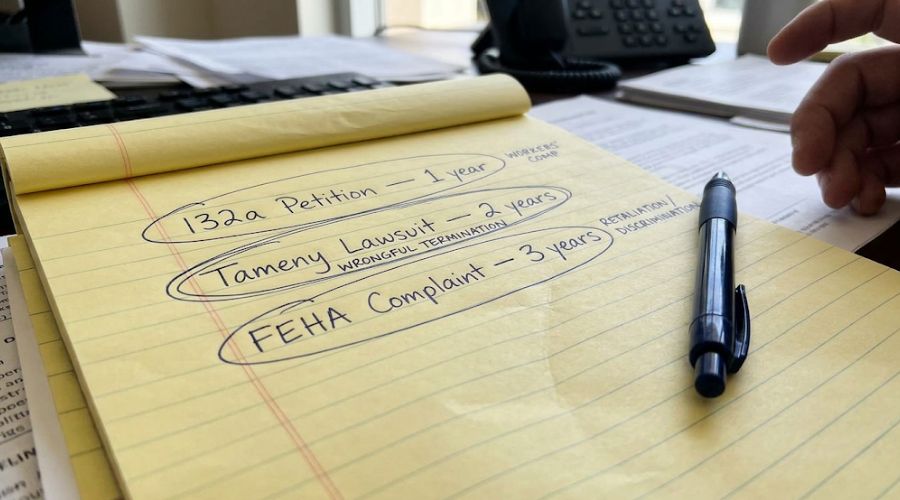
California workers’ comp retaliation law creates three independent legal remedies with three different filing deadlines — and all three clocks start running from the date of the retaliatory act. Missing any one deadline permanently bars that specific remedy.
El Labor Code Section 132a petition must be filed with the Workers’ Compensation Appeals Board within one year of the discriminatory act. This is the primary workers’ compensation system remedy — the one that produces the 50% penalty, reinstatement, and back pay through the WCAB process. It is the fastest and most direct remedy for workers who want to challenge the retaliation within the workers’ compensation system itself.
El Tameny wrongful termination civil lawsuit must be filed in superior court within two years of the termination. A Tameny claim — named for the California Supreme Court case Tameny v. Atlantic Richfield Co. (1980) — is a common law wrongful termination in violation of public policy action that can add emotional distress damages and punitive damages not available through the WCAB 132a petition process. For serious retaliation cases involving significant income loss and egregious employer conduct, the Tameny lawsuit often produces the largest total recovery.
El FEHA disability discrimination complaint must be filed with California’s Civil Rights Department within three years. When a work injury also qualifies as a disability under the Fair Employment and Housing Act, a separate disability discrimination claim may run alongside the workers’ comp retaliation claim — adding additional remedies including compensatory damages for emotional distress and, in severe cases, punitive damages. These three remedies are not mutually exclusive — pursuing all three simultaneously, with different deadlines and different damage profiles, is the approach that produces the most complete recovery for seriously retaliated-against workers. Contact an attorney immediately — the shortest deadline, the 132a petition, expires in one year.
What You Can Recover — The Full Remedy Picture
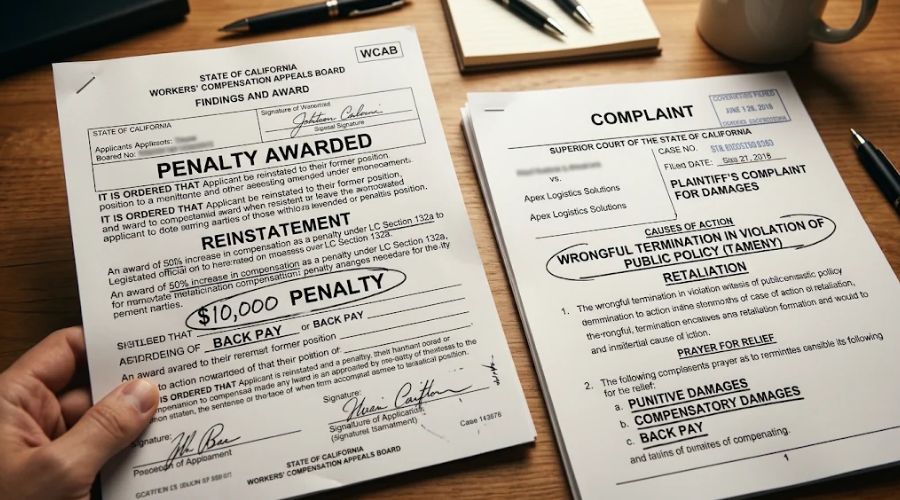
The remedies available under California workers’ comp retaliation law are more comprehensive than most workers realize. Under Labor Code Section 132a, the WCAB can award a 50% increase in the underlying workers’ compensation benefits — capped at $10,000 in additional compensation — as a penalty against the employer. This penalty is paid on top of the workers’ comp benefits the worker was already entitled to. Reinstatement to the same or comparable position is available and can be ordered by the WCAB. Reimbursement for all lost wages, benefits, and costs caused by the retaliation is separately recoverable.
The Tameny civil lawsuit adds emotional distress damages — compensation for the psychological harm caused by the wrongful termination — and punitive damages when the employer’s conduct was particularly malicious or oppressive. Punitive damages in California wrongful termination cases can substantially exceed the compensatory damage award in serious cases.
Attorney fees may also be recoverable in FEHA claims, making the full financial picture of a successful workers’ comp retaliation case significantly larger than the $10,000 WCAB penalty alone suggests. For more on how retaliation claims interact with the workers’ compensation benefits you are still entitled to receive regardless of the retaliation, see our post on Qué esperar de un abogado de compensación laboral en el condado de Orange..
What Retaliation Doesn’t Do — Your WC Benefits Are Protected
One of the most important things to understand about employer retaliation is what it cannot do: retaliation does not affect your entitlement to workers’ compensation benefits. Your right to medical treatment, temporary disability wage replacement, and permanent disability benefits exists independently of your employment status. Being fired after filing does not terminate your workers’ comp claim. Your employer’s insurer must continue processing the claim, authorizing medical treatment, and paying benefits regardless of whether you are still employed.
This means that a retaliated-against worker is pursuing two parallel tracks simultaneously: continuing the workers’ comp claim for the injury benefits, and pursuing the retaliation claim for the wrongful termination remedies. Both tracks move forward at the same time. The retaliation does not give the insurer any additional grounds to deny the underlying injury claim — those are separate determinations governed by different legal standards. For more on what happens when an insurer attempts to use the termination as a basis for denying or reducing workers’ comp benefits, see our post on ¿Qué hacer cuando se suspenden las prestaciones por accidente laboral en California?.
The California At-Will Myth — Why “At-Will Employment” Does Not Protect This Firing
The most common misconception workers have when they are told they are being fired is that California’s at-will employment doctrine means the employer can fire them for any reason. At-will employment is real — but it has well-established exceptions, and workers’ comp retaliation is one of the most clearly codified. At-will employment does not allow an employer to fire a worker for an illegal reason — and firing someone because they filed a workers’ compensation claim is specifically and explicitly illegal under Labor Code Section 132a.
When an employer frames a retaliatory firing as a layoff, a performance-based termination, or a “business restructuring,” that framing does not change the underlying legal analysis. The question is not what label the employer put on the termination — it is whether the workers’ comp filing was a substantial motivating factor in the decision.
The timing of the termination relative to the filing, the quality of performance reviews before and after the filing, the treatment of similarly situated employees who did not file, and any statements made by supervisors about the claim are all evidence that the true motive was retaliation regardless of the label applied. For more on how your underlying workers’ comp claim is protected throughout this process, see our guide on Compensación laboral versus lesiones personales en California.
Preguntas frecuentes
Can I be fired for filing workers’ comp in California?
What is the SB 497 90-day rule for workers’ comp retaliation in California?
What are the deadlines to file a workers’ comp retaliation claim in California?
What remedies are available if I am fired for filing workers’ comp in California?
Does my employer have to give me my job back if I win a 132a retaliation case?
Fired After Filing Workers’ Comp? The Clock Is Already Running
The one-year deadline for a Labor Code 132a WCAB petition starts running from the day of the retaliatory act — not from the day you decide to act on it. Oracle Law Firm | Accident & Injury Attorneys handles workers’ compensation retaliation claims throughout Southern California with no upfront fees and no obligation. You only pay if we recover additional compensation for you.
Contacta hoy mismo con nuestro equipo. — before the deadline closes on any of your remedies.