Anaheim hospitality workers injuries are among the most common workers’ compensation claims filed in Orange County — and among the most frequently disputed. Anaheim’s hospitality sector is built on some of the largest entertainment and convention venues in California: Disneyland Resort, the Anaheim Convention Center, Honda Center, and hundreds of hotels along Harbor Boulevard and the Resort District corridor. Together they employ tens of thousands of workers in roles that carry well-documented physical demands — lifting, standing for extended periods, repetitive motion, and guest-facing environments that create exposure to slip hazards, burns, and in some cases workplace violence. California workers’ compensation protects every one of these workers, regardless of role, hours, or immigration status. This guide explains your rights and what to do when an injury happens.
Anaheim Hospitality Workers Injuries: Who Is Covered and Why It Matters
California workers’ compensation covers every employee at any employer with one or more employees — including part-time workers, tipped workers, seasonal employees, and workers in any immigration status. In Anaheim’s hospitality sector, this means coverage extends to housekeepers, cooks, dishwashers, servers, bartenders, bellhops, maintenance workers, event staff, security personnel, front desk agents, and every other role in a hotel, resort, restaurant, or convention venue. The no-fault nature of California’s workers’ compensation system means you do not need to prove your employer did anything wrong — only that your injury arose out of and in the course of your employment.
In 2024, OSHA recorded 20,525 reported work-related injuries and illnesses in the accommodation and food services industry nationally — a figure that represents only formally reported incidents and does not capture the significantly larger number of injuries that go unreported due to fear of job loss, lack of awareness of rights, or employer pressure to handle injuries informally. According to the California Division of Workers’ Compensation, every California hospitality employer is legally required to carry workers’ compensation insurance and must provide the DWC-1 claim form within one working day of learning about any work-related injury. For a complete breakdown of every benefit category your claim may include, see our post on what benefits you are entitled to after a workplace injury in California.
The Most Common Injuries for Anaheim Hotel and Resort Workers
Anaheim’s hospitality workforce faces a distinct set of physical demands that produce predictable injury patterns across job categories. Understanding which injuries are most common in your specific role is the starting point for recognizing when a developing condition may be work-related — even when it developed gradually rather than from a single incident.
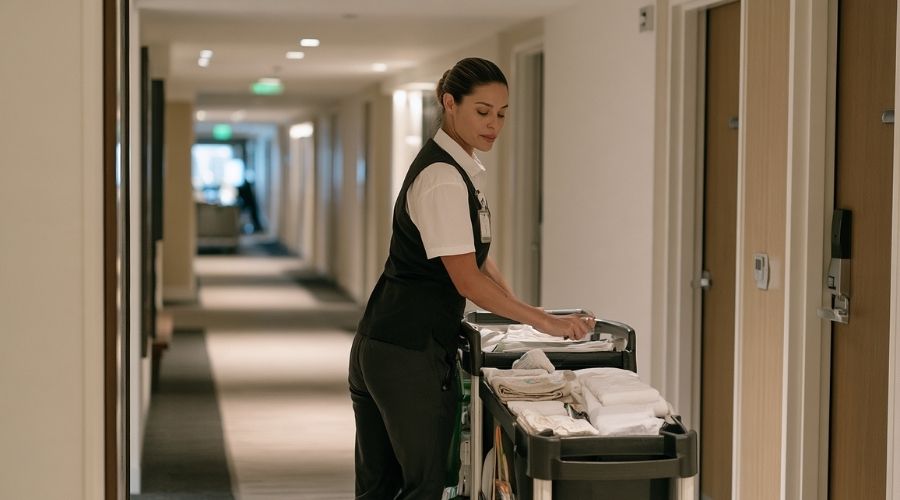
Housekeepers and room attendants face some of the highest injury rates in the hospitality industry. The combination of repetitive bending, lifting mattresses and linens, pushing heavy carts, scrubbing bathrooms, and working in cramped spaces for extended shifts produces back injuries, shoulder injuries, knee injuries, and cumulative trauma conditions including carpal tunnel syndrome and tendinitis. A housekeeper who develops chronic lower back pain after years of room cleaning has a compensable cumulative trauma claim even if no single incident caused the condition.
Kitchen workers — cooks, dishwashers, and food prep staff — face burns from hot surfaces and steam equipment, cuts from knives and broken dishware, slip-and-fall injuries on wet kitchen floors, and repetitive motion injuries from chopping, stirring, and sustained standing. Kitchen environments in large resort and convention center operations are high-volume, fast-paced workplaces where inadequate footwear, slippery surfaces, and equipment failures create acute injury risk on top of the chronic strain of extended physical labor.
Servers, bartenders, and front-of-house staff face slip-and-fall injuries from wet floors in dining and bar areas, back and shoulder injuries from carrying heavy trays, and repetitive motion conditions from sustained service work. Event and banquet staff at large-scale Convention Center events face additional exposure from staging, furniture setup, and rapid-turnover food service that compresses physical demands into high-intensity work periods.
Maintenance and engineering workers at Anaheim hotels and resorts face the full range of construction and facilities maintenance injuries: falls from ladders and elevated surfaces, electrical exposure, chemical burns from cleaning and HVAC work, and musculoskeletal injuries from sustained manual labor. These workers frequently interact with third-party contractors and vendors on the property — which can create third-party liability exposure that goes beyond the workers’ compensation system, as discussed later in this post.
Cumulative Trauma Claims — When the Injury Develops Gradually
One of the most important and most underutilized workers’ compensation protections for Anaheim hospitality workers is the cumulative trauma claim. A cumulative trauma injury is one that develops gradually over time from repeated physical stresses of the job — not from a single identifiable incident. Back pain that developed over years of housekeeper work, shoulder injuries from extended food service labor, carpal tunnel syndrome from sustained repetitive tasks — all of these can qualify as compensable work injuries under California’s cumulative trauma framework.
The reporting and filing deadlines for cumulative trauma injuries are governed by the discovery rule under Labor Code Section 5412: the one-year filing clock starts when you knew or should have known that you had a disability caused by your employment — not when symptoms first appeared. This means a worker who only recently had a physician connect their chronic shoulder condition to their housekeeping work may still have a valid claim even if the condition developed over years. Many Anaheim hospitality workers with compensable cumulative trauma conditions never file a claim because they assume a gradual injury is not covered. It is. For more on cumulative trauma deadlines and how they work, see our post on how long you have to report a work injury in California.

What to Do Immediately After a Workplace Injury in Anaheim
The steps taken in the first hours and days after a workplace injury in Anaheim have a direct impact on the strength of the workers’ compensation claim that follows. Report the injury to your supervisor or employer immediately — California law requires notification within 30 days of the injury or the discovery that a condition is work-related, and same-day reporting eliminates the most common insurer argument that the injury was not work-related.
Request the DWC-1 workers’ compensation claim form from your employer. Your employer must provide it within one working day of learning about the injury. Complete your section of the form — describing the injury, the date, and the body parts affected — and keep a copy before returning it. Once submitted, your employer’s insurer has 90 days to accept or deny the claim. During those 90 days, up to $10,000 in medical treatment must be authorized regardless of the claim’s acceptance status. Seek medical treatment promptly — even if the injury seems minor. Delayed medical care creates a gap in the documentation that insurers use to argue that the injury was not as serious as claimed or did not arise from work. For a detailed step-by-step guide to the reporting and filing process, see our post on how long you have to report a work injury in California.
Benefits Available to Injured Anaheim Hospitality Workers
California workers’ compensation provides injured Anaheim hospitality workers with 100% coverage of all reasonable and necessary medical treatment, temporary disability payments replacing two-thirds of average weekly wages up to the 2026 maximum of $1,764.11 per week, permanent disability benefits when an injury leaves lasting impairment, the Supplemental Job Displacement Benefit voucher when modified work is unavailable, and death benefits for qualifying dependents when an injury results in death.
Two categories of benefits are especially significant for hospitality workers. First, the average weekly wage calculation must include all compensation — base wages, overtime, tips, and income from any concurrent employer. Tipped workers whose AWW is understated by omitting tip income receive systematically underpaid TTD and PPD benefits throughout the entire claim. Second, permanent disability benefits apply to cumulative trauma conditions just as they apply to acute injuries — a housekeeper who reaches MMI with a lasting spinal or shoulder impairment is entitled to a permanent disability rating and the associated payments regardless of whether the injury happened in a single incident or accumulated over years. For the 2026 TTD and PPD rate figures and how they are calculated, see our guide on how much workers’ comp pays in California.
Employer Retaliation — What Is and Is Not Legal in Anaheim
One of the most significant barriers to workers’ compensation claims in Anaheim’s hospitality sector is employer pressure — implicit or explicit — against reporting injuries or filing claims. Large employers with high claim volumes have financial incentives to manage injury reporting, and smaller hospitality operations sometimes use the threat of job loss or scheduling reductions to discourage workers from pursuing their legal rights. None of this is lawful.
Retaliation against an employee for reporting a work injury or filing a workers’ compensation claim is illegal under California Labor Code Section 132a, which carries penalties of up to $10,000 plus reinstatement and lost wages. Under Senate Bill 497, adverse employment action within 90 days of a protected workers’ comp filing creates a rebuttable presumption of retaliation. California workers’ compensation protections apply to all employees regardless of immigration status — an undocumented worker has the same right to file a workers’ compensation claim as any other California employee, and threatening immigration enforcement in response to a workers’ comp filing is itself a legally actionable form of retaliation. For more on what to do when an employer lacks workers’ comp coverage entirely — a scenario that occurs in some smaller Anaheim hospitality operations — see our post on what to do if your employer has no workers’ comp insurance.
The Anaheim WCAB Office — What Local Jurisdiction Means for Your Claim
The Workers’ Compensation Appeals Board maintains a district office that serves Anaheim and the surrounding Orange County area. Workers’ compensation hearings, mandatory settlement conferences, and QME appointments for Anaheim-area claims are handled through this local WCAB infrastructure. Having a workers’ compensation attorney whose practice regularly appears before the Anaheim WCAB office brings familiarity with the specific judges, scheduling practices, and procedural norms that affect how a disputed claim moves through the system.
Local WCAB familiarity matters in practical terms: knowing which judges take a more conservative view of cumulative trauma claims, which expedited hearing tracks are available for urgent medical disputes, and how the local calendar affects settlement conference timing all shape the strategy for a disputed claim in ways that general workers’ compensation knowledge alone does not provide. For more on what the WCAB process looks like for an injured worker from the first filing through resolution, see our complete guide on what to expect from a workers’ compensation attorney in Orange County.

When a Third-Party Claim May Also Apply
Workers’ compensation is the primary but not always the exclusive source of recovery for Anaheim hospitality workers injured on the job. When a third party — someone other than the employer — contributed to causing the injury, a separate personal injury claim against that third party may be available alongside the workers’ compensation claim. This happens more often in the hospitality sector than most workers realize.
Common third-party scenarios in Anaheim hospitality settings include: a delivery driver who causes a vehicle accident during a work-related errand, a contractor whose negligent repair work created a slip hazard that caused a fall, a defective piece of kitchen equipment manufactured by an outside company, or a vendor whose actions at a Convention Center event created a hazardous condition. In each of these cases, the workers’ compensation claim runs against the employer’s insurer and the personal injury claim runs against the negligent third party — and both can proceed simultaneously. The third-party claim provides access to pain and suffering and full lost wages that workers’ compensation does not cover, potentially producing significantly larger total compensation in serious injury cases. For a full explanation of how dual claims work, see our post on workers’ comp vs personal injury in California.
Frequently Asked Questions
Are Anaheim hospitality workers covered by workers’ compensation in California?
What are the most common injuries for Anaheim hotel and resort workers?
What should I do if I am injured working at a hotel or resort in Anaheim?
Can my employer retaliate against me for filing a workers’ comp claim in Anaheim?
Where are Anaheim workers’ compensation hearings held?
Injured Working in Anaheim Hospitality? Talk to an Attorney Today
Anaheim hospitality workers face some of the most physically demanding conditions in Orange County — and some of the most aggressively managed workers’ compensation claims. Oracle Law Firm | Accident & Injury Attorneys helps injured hotel, resort, and food service workers throughout Anaheim and Southern California secure every benefit they are entitled to, with no upfront fees and no obligation. Contact our team today — in English or Spanish — before any reporting deadline passes.