Shoulder and knee work injuries are two of the most expensive and most disputed categories of workers’ compensation claims in California. When a rotator cuff tears on a construction site or a meniscus gives way in a warehouse, the cost of surgery, rehabilitation, and permanent disability is substantial — and insurance carriers respond with a predictable set of claim disputes designed to minimize that cost. Understanding the five most common disputes in shoulder and knee work injury claims, and knowing how each one is countered, is the practical knowledge that separates a fairly valued settlement from one that leaves significant compensation behind.
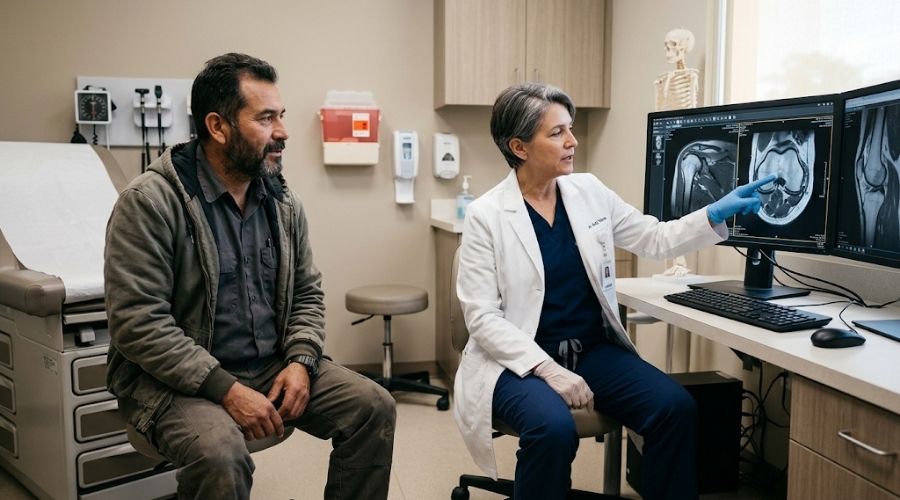
Shoulder and Knee Work Injuries: Why These Two Body Parts Are Disputed Most
Shoulder and knee work injuries generate the highest claim dispute rates in California workers’ compensation for a specific reason: they are both joints with well-documented degenerative changes that occur naturally with age, making pre-existing condition arguments easy to raise and difficult to rebut without strong medical documentation. A 45-year-old worker who tears their rotator cuff lifting at work will almost always have some degree of pre-existing degeneration visible on MRI — giving the insurer’s physician a factual hook for apportionment that does not exist with a broken bone or a laceration.
The financial stakes compound the dispute incentive. Shoulder injuries average $55,000 in workers’ compensation settlements statewide, with surgical cases ranging from $60,000 to $120,000 and complex cases reaching $200,000 or more. Knee injuries average $50,000, with surgical cases commonly settling between $40,000 and $100,000. According to the California Division of Workers’ Compensation, shoulder and knee injuries consistently rank among the highest-cost claims in the system — which means every percentage point the insurer reduces through dispute tactics produces meaningful savings on their side and meaningful losses on yours. For a complete breakdown of how California workers’ compensation benefits are calculated and what your AWW determines, see our guide on how much workers’ comp pays in California.
Dispute 1 — Causation: “The Injury Is Not Work-Related”
The first and most fundamental dispute in shoulder and knee work injury claims is causation — the insurer’s argument that the injury was not caused by the job. This argument takes several forms: that the injury predated employment, that a specific incident did not occur as described, that the mechanism of injury described is inconsistent with the diagnosed condition, or that the condition is purely degenerative and unrelated to work activities.
California law applies a relatively favorable causation standard for injured workers: employment must be a contributing cause of the injury, not the sole cause. A rotator cuff tear that was accelerated or aggravated by years of overhead work qualifies as a work-related injury even when some degeneration existed before employment began. The legal concept of the “aggravation” of a pre-existing condition is well established in California workers’ compensation — and distinguishing a work-related aggravation from a purely natural disease progression is a medical determination that a strong treating physician’s opinion and a well-prepared QME evaluation can establish clearly.
The most effective tools for challenging causation disputes are a detailed job description that specifically documents the physical demands of the work, a treating physician’s report that directly connects those demands to the diagnosed condition, and where applicable a biomechanical or ergonomic expert opinion. Same-day or next-day injury reports that document the specific mechanism of injury — what you were doing, what body position you were in, what you felt — are the foundational evidence that makes causation arguments most credible. For more on how and when to report work injuries to protect causation evidence, see our post on how long you have to report a work injury in California.
Dispute 2 — Surgery Authorization: Utilization Review and IMR
When a treating physician recommends surgery for a shoulder or knee work injury — a rotator cuff repair, an ACL reconstruction, a meniscectomy, or a total knee replacement — the insurer’s Utilization Review process evaluates whether that recommendation meets evidence-based medical treatment guidelines before authorizing it. UR is conducted by a physician hired by the insurer, and UR denials of recommended surgeries are common in shoulder and knee cases, particularly when the treating physician’s documentation of medical necessity is incomplete or does not specifically address the MTUS criteria.
A UR denial is not the end of the road. Under California’s Independent Medical Review process — established by SB 863 (2012) — a UR denial can be appealed to an IMR organization, which evaluates the treating physician’s recommendation against the same evidence-based guidelines using a neutral reviewer. IMR decisions override UR denials in a significant proportion of well-documented surgical cases. The key is the quality of the treating physician’s documentation: the IMR reviewer evaluates the treating doctor’s request as submitted, which means requests that clearly address the MTUS criteria and document medical necessity with specific clinical findings produce better IMR outcomes than those that do not.
Surgery dramatically affects settlement value. A rotator cuff tear that settles without surgery at $25,000–$40,000 can settle at $75,000–$150,000 after surgical repair when permanent restrictions are properly documented. A denied surgery that goes through IMR and is ultimately approved produces not only the medical benefit but also a longer TTD period, higher permanent disability exposure, and a significantly stronger settlement position. For more on how the QME process interacts with surgery disputes and permanent disability ratings, see our post on what a QME is and why it matters to your claim.
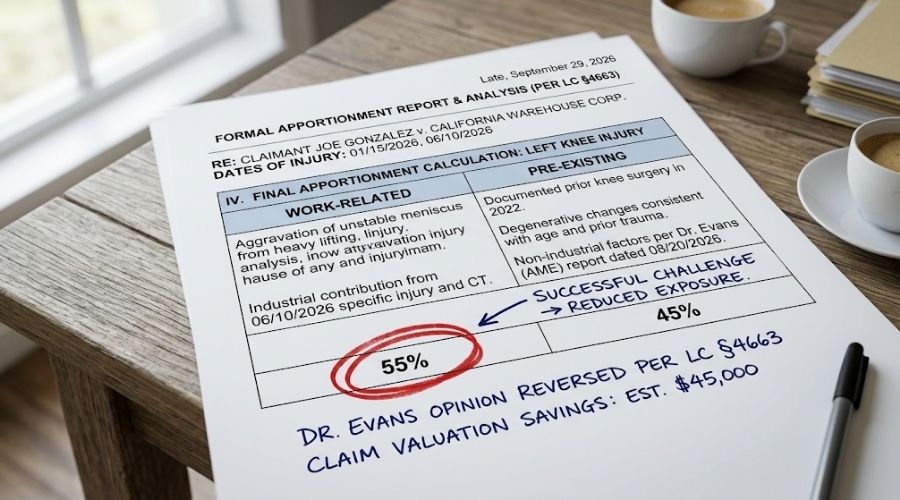
Dispute 3 — Pre-Existing Conditions and Apportionment
Pre-existing condition arguments are the most financially significant dispute type in shoulder and knee work injury cases in California. Under California Labor Code Section 4663, if a physician determines that a portion of permanent disability pre-existed the work injury or was caused by non-industrial factors, that portion is carved out of the employer’s responsibility. The employer’s insurer pays only for the work-related share.
In shoulder cases, the pre-existing condition argument focuses on age-related degeneration of the rotator cuff — the natural thinning and fraying of tendon tissue that appears on MRI in most workers over 40. An insurer’s physician who apportions 50% of a rotator cuff tear to “degenerative changes” cuts the employer’s permanent disability exposure in half. In knee cases, the same argument is applied to meniscal degeneration, chondromalacia, and arthritic changes visible on imaging.
The California Supreme Court’s decision in Escobedo v. Marshalls (2005) established that apportionment requires a physician to identify the specific percentage attributed to work versus non-work causes based on substantial medical evidence — not speculation or general age-based assumptions. An apportionment opinion that simply notes “degenerative changes consistent with age” without specifically addressing how the work injury independently contributed to the current condition does not meet the legal standard and can be challenged through the QME process. A treating physician who specifically documents the work injury’s contribution — “this worker’s job duties requiring daily overhead lifting accelerated degeneration and produced a full-thickness tear that would not have occurred absent occupational exposure” — provides the counter-evidence that limits aggressive apportionment. For more on how apportionment disputes affect permanent disability ratings, see our post on temporary vs permanent disability in California.
Dispute 4 — Permanent Disability Rating Contests
When a shoulder or knee work injury results in permanent impairment after maximum medical improvement, the permanent disability rating determines the weekly benefit amount and total duration of PPD payments — and the difference between a 15% rating and a 30% rating on the same injury can be tens of thousands of dollars in total benefit entitlement. Insurers’ QME physicians systematically produce lower disability ratings than treating physicians for shoulder and knee injuries, and this rating gap is one of the most common and financially significant disputes in these cases.
Shoulder ratings under the AMA Guides are determined by range of motion measurements and specific functional deficit criteria. The accuracy of those measurements during a QME examination is directly affected by how thoroughly the injured worker demonstrates their actual limitations — not their best-day performance. Knee ratings similarly depend on range of motion, stability testing, and documentation of specific functional restrictions. A QME examination in which the injured worker minimizes symptoms out of habit or stoicism produces a lower rating than the injury warrants. Preparation before a QME examination — knowing what the physician will measure, how to accurately demonstrate current limitations, and what daily activity restrictions to describe in concrete terms — produces materially better rating outcomes.
When the QME rating is lower than the treating physician’s opinion and the evidence supports a higher rating, the dispute goes to the Workers’ Compensation Appeals Board. A workers’ compensation judge evaluates the competing medical evidence and issues a binding determination on the appropriate rating. The financial difference between prevailing and losing at this stage frequently exceeds the cost of legal representation — which is why permanent disability rating disputes in shoulder and knee cases are among the most important and most productively litigated issues in California workers’ compensation. For more on how the QME panel process works and how to challenge an inadequate report, see our guide on what a QME is and why it matters to your claim.
Dispute 5 — Return to Work and Modified Duty Disputes
The fifth common dispute category in shoulder and knee work injury cases involves return to work — specifically, whether a modified duty offer made by the employer genuinely accommodates the injured worker’s medical restrictions or represents a tactical attempt to terminate TTD benefits without providing meaningful accommodation. California law allows an employer to make a modified duty offer that, if the worker declines without medical justification, can be used to end temporary disability payments.
In shoulder and knee injury cases, the dispute frequently centers on whether the offered modified duty actually complies with the treating physician’s restrictions. An employer who offers modified work that requires the injured worker to stand for extended periods when the treating physician has restricted standing, or that involves repetitive use of the injured limb when the physician has restricted repetitive motion, has not made a legitimate modified duty offer — even if the offer is labeled as such. Documenting the specific duties of the offered position and comparing them against the specific language of the physician’s work restrictions is the analysis that determines whether the offer is genuine and whether declining it has legal consequences. For more on how modified duty offers interact with temporary disability benefits, see our guide on what to do when workers’ comp benefits stop in California.
2026 Settlement Ranges for Shoulder and Knee Work Injuries
Settlement values for shoulder and knee work injuries in California in 2026 reflect the interaction of all five dispute categories above — which is why the same injury type produces such a wide range of outcomes. The ranges below reflect documented California workers’ compensation case outcomes and are provided as orientation, not predictions for any individual case.
For shoulder injuries: non-surgical soft tissue injuries typically settle between $20,000 and $40,000. Partial rotator cuff tears without surgery commonly settle between $30,000 and $60,000. Full rotator cuff tears requiring surgical repair typically settle between $60,000 and $120,000. Complex shoulder cases involving two surgeries, significant permanent restrictions, and successfully challenged apportionment have settled at $195,000 and higher. The average across all shoulder injury settlements is approximately $55,000.
For knee injuries: non-surgical meniscal and ligament injuries typically settle between $15,000 and $40,000. Arthroscopic meniscectomy and ACL reconstruction cases commonly settle between $40,000 and $100,000. Total knee replacement cases regularly settle above $100,000 when future medical costs and permanent restrictions are properly documented. Long-term post-traumatic arthritis adds future medical value that can significantly increase a knee injury settlement beyond the initial disability rating calculation would suggest. The average across all knee injury settlements is approximately $50,000. For more on how permanent disability ratings translate into specific weekly payment amounts and total settlement values, see our complete breakdown in our post on how much workers’ comp pays in California.
What Documentation Matters Most in Shoulder and Knee Claims
The single most consistent factor separating well-valued shoulder and knee work injury settlements from underpaid ones is documentation quality. Specific, contemporaneous injury reports that describe the exact mechanism of injury, the body position, the weight or force involved, and the immediate symptoms create a factual record that is very difficult for the insurer to challenge. Vague or delayed injury reports create the space that causation disputes exploit.
Consistent medical treatment with a physician who specifically documents the functional limitations of the injury — what the worker cannot do, at what pain level, for how long — builds the medical record that supports both surgery authorization through IMR and an accurate permanent disability rating through the QME process. Gaps in treatment, minimized symptom reporting, and medical records that focus on diagnosis without documenting functional impact all produce lower ratings and lower settlements. A daily journal of symptoms, limitations, and activities you can no longer perform is one of the most practical and consistently effective documentation tools available to an injured worker without any legal training required to use it. For a broader guide to what the workers’ comp claim process looks like from injury through settlement, see our post on what to expect from a workers’ compensation attorney in Orange County.
Frequently Asked Questions
How much is a shoulder injury workers’ comp settlement in California in 2026?
How much is a knee injury workers’ comp settlement in California in 2026?
Can an insurer deny surgery for a shoulder or knee work injury in California?
Can a pre-existing shoulder or knee condition reduce my workers’ comp settlement?
What jobs most commonly produce shoulder and knee work injuries in California?
Shoulder or Knee Work Injury Disputed? Talk to an Attorney Before Accepting Anything
Shoulder and knee work injury claims face more insurer disputes than almost any other workers’ compensation category — and the financial difference between a disputed and a well-represented outcome is measurable and significant. Oracle Law Firm | Accident & Injury Attorneys handles disputed shoulder and knee workers’ compensation claims throughout Southern California, with no upfront fees and no obligation. Contact our team today before any settlement offer is accepted or any IMR deadline passes.