Warehouse injury in the Inland Empire is one of the most common workers’ compensation scenarios in California — and one of the most frequently mishandled by injured workers who do not know what their rights are. The Inland Empire handles nearly 40% of America’s imported goods through a network of massive distribution and fulfillment centers that employs over 200,000 workers across Riverside and San Bernardino counties.
The warehouse injury rate in this corridor is among the highest in California, and it has remained elevated despite the passage of AB 701’s quota protections. If you were hurt at an Inland Empire warehouse, you have specific rights under California law — and this guide explains every one of them.

Warehouse Injury Inland Empire: California Workers’ Comp Covers You From Day One
California workers’ compensation covers every Inland Empire warehouse worker from the first day of employment — full-time, part-time, temporary, and seasonal workers alike. The system operates on a no-fault basis under California Labor Code Section 3600: you do not need to prove your employer did anything wrong. You need only show that your injury arose out of and in the course of your employment.
A back injury from lifting a 70-pound package, a forklift collision, a slip on a wet warehouse floor, or a gradual shoulder condition from years of repetitive picking tasks — all qualify as compensable work injuries if they arose from your warehouse job.
Coverage applies regardless of immigration status. Coverage applies to temp workers placed through staffing agencies. Coverage applies to workers who were partially responsible for their own injury under California’s no-fault framework. The one requirement that most commonly derails Inland Empire warehouse claims is not legal eligibility — it is failure to report the injury within the 30-day notification window under Labor Code Section 5400.
According to the California Division of Workers’ Compensation, every California employer must provide a DWC-1 claim form within one working day of learning about a work injury. If your employer is refusing to provide the form, that refusal is itself a violation. For a complete guide to reporting deadlines and the DWC-1 process, see our post on how long you have to report a work injury in California.
The Most Common Warehouse Injuries in the Inland Empire
Inland Empire warehouse injuries follow predictable patterns that reflect the specific physical demands of large-scale distribution and fulfillment work. Understanding which injury types are most common in your role is the starting point for recognizing when a developing condition may be compensable — even when it developed gradually rather than from a single incident.
Back and shoulder injuries from lifting and repetitive motion are the single most prevalent workers’ compensation injury category in Inland Empire warehouses. Workers who repeatedly lift, carry, push, and pull heavy items across long shifts develop lumbar spine conditions, disc herniations, rotator cuff damage, and shoulder impingement at rates significantly above the general workforce. These injuries frequently develop gradually — as cumulative trauma conditions — rather than from a single identifiable event, which is why the date-of-injury rules under Labor Code Section 5412 are particularly important for warehouse workers.
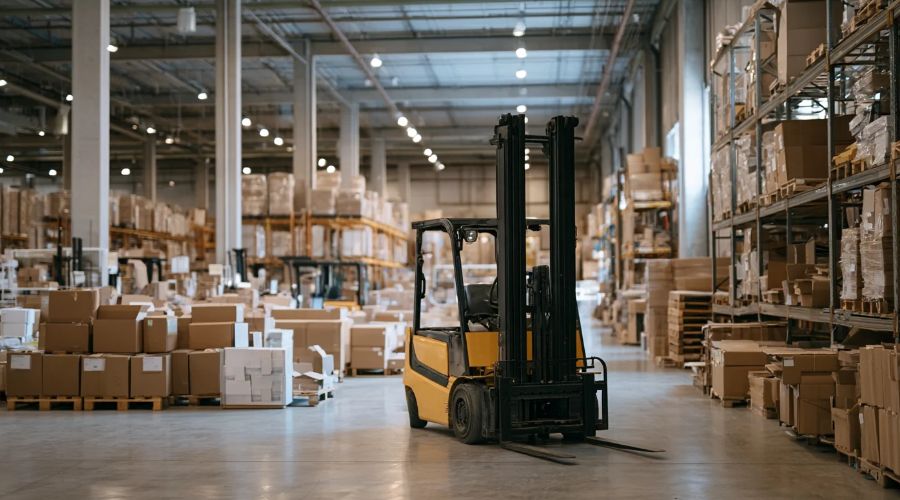
Forklift and powered industrial vehicle accidents produce some of the most severe acute injuries in the IE warehouse environment — crushing injuries, fractures, traumatic brain injuries, and in the worst cases fatalities. When a forklift accident is caused by a defect in the equipment rather than solely by operator error, the forklift manufacturer may bear third-party product liability alongside the workers’ comp claim against the employer. Identifying that product liability angle is one of the most consequential early steps in a serious forklift injury case.
Slip-and-fall and struck-by-object injuries occur regularly in warehouse environments where spills, wet floors, debris from damaged packaging, and falling merchandise from improperly stacked shelving create constant hazard exposure. These injuries often involve sudden fractures, head injuries, and knee damage that can produce both acute treatment needs and lasting permanent impairment.
Cumulative trauma conditions — carpal tunnel syndrome from sustained scanning and packing tasks, tendinitis from repetitive reaching and gripping, knee and hip degeneration from sustained standing on concrete floors — are compensable work injuries even when they developed over months or years rather than from a single event.
The discovery rule under Labor Code Section 5412 gives workers a one-year filing window from the date they knew or should have known the condition was work-related — not from when symptoms first appeared. For a full explanation of how cumulative trauma claims work and their specific deadlines, see our post on repetitive stress and cumulative trauma claims at work.

AB 701 — How the Warehouse Quota Law Protects You and Strengthens Your Claim
California’s Assembly Bill 701, effective January 1, 2022, is one of the most important legal protections for Inland Empire warehouse workers — and one that directly interacts with workers’ compensation claims. AB 701 applies to warehouses with 100 or more employees at a single site or 1,000 or more statewide. Under the law, covered employers must disclose all productivity quotas to workers in writing and are prohibited from enforcing quotas that prevent workers from taking legally mandated meal and rest breaks, using the bathroom, or following health and safety rules.
AB 701’s direct connection to workers’ compensation comes through Labor Code Section 2107: when a warehouse’s injury rate is at least 1.5 times the industry average, Cal/OSHA and the Division of Workers’ Compensation must be notified, which can trigger a quota violation investigation. If an unsafe quota contributed to your warehouse injury — by pressuring you to move faster than is safe, preventing you from following safe lifting procedures, or denying you rest breaks that would have prevented a cumulative trauma condition — that documentation can strengthen your workers’ comp claim by directly connecting the employer’s unlawful quota to the physical harm you suffered.
AB 701 also gives you the right to request a copy of your productivity quota in writing and your performance data. Requesting this information after a workplace injury creates a documented record of the quota requirements you were operating under — evidence that becomes highly relevant when an insurer argues your injury was caused by personal factors rather than the demands of the work. The Warehouse Worker Resource Center, which championed AB 701, is based in Ontario — at the heart of the Inland Empire logistics corridor — and remains a resource for workers whose AB 701 rights have been violated.
Temp Workers — You Are Covered Too
A significant portion of the Inland Empire’s warehouse workforce is employed through staffing agencies — Manpower, Adecco, Kelly Services, and dozens of regional agencies that place workers at Amazon, UPS, Walmart, and other major distribution operations. Temp workers are among the most frequently injured warehouse employees — they are often newer to the physical demands of the job, less familiar with site-specific safety procedures, and more reluctant to report injuries for fear of losing the placement.
California law covers temp workers under workers’ compensation — either through the staffing agency’s policy or the host employer’s policy, depending on how the employment relationship is legally structured. When both the agency and the host employer deny responsibility, California’s strong presumptions of employee status — established under the Dynamex ABC test and AB 5 — provide the legal framework to compel one or both to respond through the workers’ compensation system.
An employer who classifies warehouse temp workers as independent contractors to avoid workers’ compensation obligations is in violation of both Labor Code Section 3700 and the ABC test, and a misclassified worker still has full rights to seek benefits through the Uninsured Employers Benefits Trust Fund if direct coverage is denied. For more on the UEBTF and what it covers when employers lack required insurance, see our post on what to do if your employer has no workers’ comp insurance.
Third-Party Claims — When Someone Other Than Your Employer Is Also Responsible
Workers’ compensation is the primary but not always the exclusive source of recovery after a warehouse injury in the Inland Empire. When a third party — someone other than the employer — contributed to causing the injury, a separate personal injury lawsuit may be available alongside the workers’ comp claim. This happens more frequently in warehouse settings than most workers realize.
A forklift or pallet jack with a defective steering mechanism, braking system, or safety feature — manufactured by an outside company — creates product liability against the manufacturer in addition to the workers’ comp claim against the employer. A maintenance contractor whose negligent repair of racking, conveyor systems, or loading equipment created a hazardous condition is a third party whose liability falls outside the exclusive remedy rule.
A delivery driver from another company who caused an accident in the loading dock area is a third-party motorist against whom a personal injury claim lies. In each of these scenarios, the personal injury claim produces access to pain and suffering and full lost wages that workers’ compensation does not cover. For a full explanation of how dual claims work and when they apply in the warehouse context, see our post on workers’ comp vs personal injury in California.
Heat Illness — The Overlap With Workers’ Comp
Inland Empire warehouse workers face heat illness risk that is distinct from outdoor agricultural workers but just as serious. Cal/OSHA’s indoor heat illness prevention standard — Title 8 CCR Section 3396, effective July 23, 2024 — requires all indoor workplaces to provide cool water, accessible cool-down areas, and mandatory rest periods once temperatures reach 82°F and 95°F respectively. In July 2026, the Inland Empire recorded temperatures between 100 and 110 degrees outdoors — with internal warehouse temperatures in metal-roofed structures rising significantly higher.
Heat illness suffered at a warehouse is a fully compensable workers’ compensation injury in California — covering medical treatment, temporary disability wage replacement, and permanent disability when lasting organ or neurological effects result. An employer who failed to provide required cool-down access, water, or mandatory rest periods when heat illness occurred has violated Cal/OSHA regulations — and that violation is relevant to both the workers’ comp claim and any Cal/OSHA penalty proceeding. For a complete guide to heat illness workers’ comp rights specific to the Inland Empire, see our post on heat illness at work in the Inland Empire.
Retaliation Protections for Inland Empire Warehouse Workers
Employer pressure against injury reporting is a documented reality in the Inland Empire warehouse environment — particularly in high-quota operations where workers fear that reporting an injury will cost them their placement or their hours. California law provides specific, enforceable protections against every form of this pressure. California Labor Code Section 132a makes it illegal to retaliate against any employee for reporting a work injury or filing a workers’ compensation claim — carrying penalties of up to $10,000 plus reinstatement and lost wages.
AB 701 adds specific retaliation protections for warehouse workers who request quota information or report that a quota is preventing them from following health and safety procedures. Under Senate Bill 497, adverse employment action within 90 days of a protected workers’ comp filing creates a rebuttable presumption of illegal retaliation.
These protections apply regardless of immigration status — an undocumented warehouse worker has the same right to file a workers’ compensation claim and the same protection against retaliation as any other California employee. For more on rights after a workplace injury regardless of immigration status, see our post on undocumented workers and workplace injury rights.
Frequently Asked Questions
Are warehouse injuries in the Inland Empire covered by workers’ compensation?
What does California’s AB 701 warehouse quota law mean for my workers’ comp claim?
Am I covered by workers’ comp if I work through a staffing agency at an Inland Empire warehouse?
What are the most common warehouse injuries in the Inland Empire?
Can I sue someone other than my employer if I was injured in an Inland Empire warehouse?

Hurt at an Inland Empire Warehouse? Your Rights Don’t Disappear Because of a Quota
Inland Empire warehouse workers face some of California’s highest injury rates and some of the most aggressive employer pressure to stay quiet about it. Oracle Law Firm | Accident & Injury Attorneys helps injured warehouse workers throughout Riverside and San Bernardino counties exercise every right they have — in English and Spanish — with no upfront fees and no obligation. Contact our team today before any reporting deadline passes.