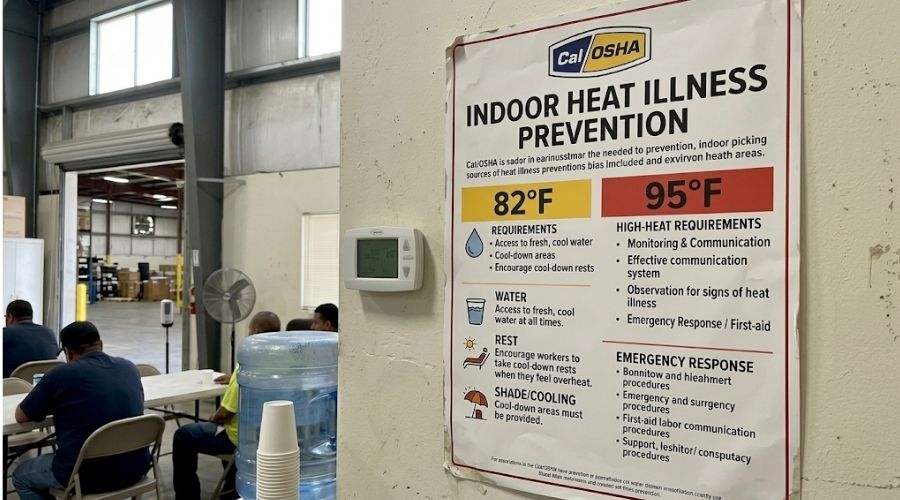
California has the strongest heat illness workplace protections in the country — and in 2024, those protections expanded significantly to cover indoor workers for the first time. Cal/OSHA’s indoor heat illness prevention standard, codified in Title 8 of the California Code of Regulations Section 3396, took effect on July 23, 2024. It applies to all indoor work areas — warehouses, distribution centers, factories, food processing plants, restaurant kitchens, and laundries — where the temperature reaches 82°F or more while employees are present.
At 82°F, employers must provide access to cool drinking water, accessible cool-down areas where workers can recover from heat, and training on recognizing and responding to heat illness. At 95°F, the standard requires mandatory cool-down rest periods of at least 5 minutes whenever a worker feels the need to cool down, before heat illness develops. Employers must also maintain a written indoor heat illness prevention plan that workers can actually access. The outdoor heat illness standard — Title 8 CCR Section 3395 — has been in effect since 2005 and applies to all outdoor work, including construction, agriculture, and landscaping. According to the División de Compensación para Trabajadores de California, heat illness caused by employment is a compensable workers’ compensation injury regardless of whether the work was performed indoors or outdoors.
Why the Inland Empire Is California’s Heat Illness Capital
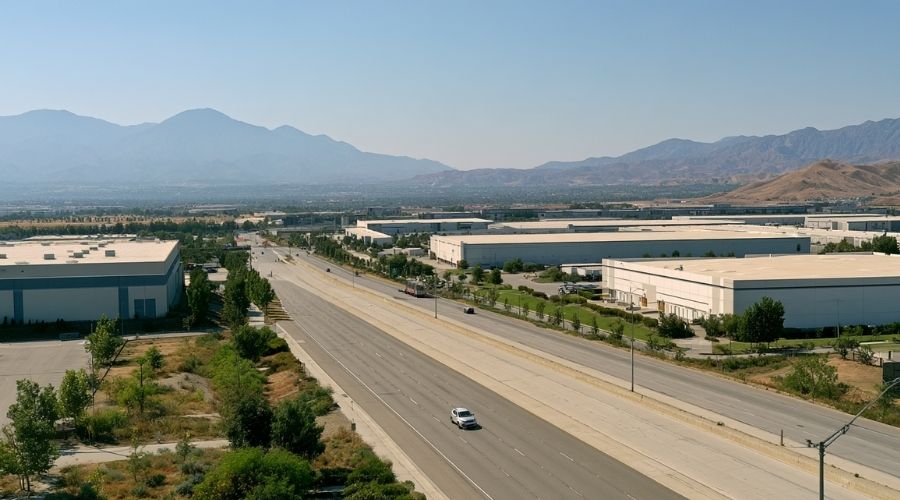
The Inland Empire’s position as America’s logistics hub creates a uniquely dangerous heat exposure environment. Riverside and San Bernardino counties handle nearly 40% of America’s imported goods through a network of massive distribution centers clustered along the I-10, I-15, I-215, and SR-60 corridors — warehouses that can span millions of square feet, feature minimal ventilation, and trap heat generated by machinery, vehicles, and the simple volume of human activity inside them. In July 2026, temperatures in parts of the Inland Empire reached 100 to 110 degrees outside — with internal warehouse temperatures climbing higher as afternoon heat builds inside structures that absorbed morning sun.
Congresswoman Norma Torres formally called on the California Labor and Workforce Development Agency in 2025 to increase protections and inspections for Inland Empire warehouse workers specifically, citing temperatures reaching nearly 100°F before Memorial Day and the inadequacy of then-existing enforcement. The agricultural sector in the eastern portions of Riverside and San Bernardino counties adds another high-risk population: field workers in citrus, grape, and date palm cultivation who face direct sun exposure without the partial shelter of a building — the population California’s outdoor heat standard was originally designed to protect. A Workers Compensation Research Institute study found that California’s heat illness regulations reduced heat-related injuries by 15 to 17% in construction, 24 to 27% in agriculture, and 19 to 25% in transportation — demonstrating both the effectiveness of the protections and the magnitude of the problem they address. For more on the workers’ compensation system that covers these injuries, see our post on ¿Qué beneficios le corresponden después de una lesión laboral en California?.
The Spectrum of Heat Illness at Work Inland Empire — What Is Covered
California workers’ compensation covers heat illness across its full spectrum — from the mildest conditions to the most life-threatening. Heat cramps are muscle spasms caused by fluid and electrolyte loss during sustained physical exertion in heat. Heat syncope is fainting or near-fainting caused by heat-induced dilation of blood vessels and inadequate blood flow to the brain. Heat exhaustion involves heavy sweating, weakness, dizziness, nausea, headache, and pale or moist skin — a serious condition requiring immediate cool-down and medical attention. Heat stroke is the most severe: a core body temperature above 104°F, confusion, loss of consciousness, cessation of sweating, and a medical emergency that carries significant risk of permanent organ damage and death.
Every one of these conditions, when caused by workplace heat exposure, is a compensable workers’ compensation injury in California. Heat illness is not limited to temporary symptoms. Severe heat stroke can cause permanent kidney damage, liver damage, cardiac effects, and neurological impairment that persist long after the acute event has resolved. When work-related heat illness produces lasting health effects, those permanent conditions qualify for permanent disability benefits under California’s Permanent Disability Rating Schedule — in addition to the full medical treatment and temporary disability benefits available during recovery. For a complete breakdown of all benefit categories and how permanent disability is rated, see our guide on Incapacidad temporal frente a incapacidad permanente en California.
Employer Obligations — What Your Employer Was Required to Do
California law places the obligation for heat illness prevention squarely on the employer — not on the worker to simply endure dangerous temperatures. Under the indoor heat standard, Inland Empire warehouse and factory employers are required to provide cool drinking water (at least 1 quart per worker per hour), accessible cool-down areas maintained below 82°F, mandatory cool-down rest periods at 95°F, training for all workers and supervisors on recognizing and responding to heat illness, and a written indoor heat illness prevention plan that workers can access.
Under the outdoor heat standard, employers must provide adequate shade for at least 25% of workers simultaneously, water that is fresh, pure, and suitably cool, high-heat procedures when temperatures reach 95°F or above, and new employee acclimatization protocols during the first 14 days of employment — a period when heat illness risk is dramatically elevated as the body adjusts to working in high temperatures. An employer who failed to provide any of these required protections when you suffered heat illness has violated Cal/OSHA regulations — and that regulatory violation is relevant to both the workers’ compensation claim and any potential third-party liability or Cal/OSHA penalty proceeding. For more on how employer violations interact with workers’ compensation claims, see our post on ¿Qué hacer si su empleador no tiene seguro de compensación laboral?.
Your Right to Refuse Unsafe Heat Conditions
One of the most important — and most frequently violated — protections for Inland Empire workers is the right to refuse work in conditions that pose an imminent danger to health. California Labor Code Section 6311 gives workers the right to refuse to perform work that violates occupational safety or health standards when that violation creates a real and apparent hazard. Working in a warehouse at 105°F without access to cool-down areas or adequate water when the indoor heat standard requires those protections at 82°F is a Cal/OSHA violation — and a worker who refuses to work under those conditions is exercising a legally protected right.
Employers frequently pressure workers — particularly in high-quota warehouse environments — to continue working through heat symptoms rather than taking required cool-down breaks. Supervisors sometimes discourage workers from using cool-down areas to maintain production pace. Both of these practices violate Cal/OSHA regulations and are specifically prohibited. Documenting when you reported heat symptoms, when you requested a cool-down break, and whether that request was denied or discouraged creates the record that both the workers’ compensation claim and any Cal/OSHA complaint will be built on.
Retaliation Protections — What Employers Cannot Do
Heat illness claims generate a predictable pattern of employer misconduct — particularly in the Inland Empire’s high-turnover warehouse environment where workers fear that reporting illness will cost them their jobs. California law provides specific protections against every form of this retaliation. California Labor Code Section 6310 makes it illegal to retaliate against a worker for complaining about unsafe heat conditions, participating in a Cal/OSHA investigation, or refusing to work in conditions that violate safety standards. Filing a workers’ compensation claim for heat illness is additionally protected under Labor Code Section 132a, which carries penalties of up to $10,000 plus reinstatement and lost wages for retaliatory discharge.
Under Senate Bill 497, adverse employment action taken within 90 days of a protected filing creates a rebuttable presumption of illegal retaliation — shifting the burden to the employer to explain the adverse action. These protections apply regardless of immigration status. An undocumented worker who suffers heat illness at an Inland Empire warehouse has the same right to file a workers’ compensation claim and the same protection against retaliation as any other California employee. For more on how retaliation protections work specifically for workers concerned about their immigration status, see our post on undocumented workers and workplace injury rights.
How to File a Heat Illness Workers’ Comp Claim in the Inland Empire
If you experience heat illness symptoms at work, stop work and seek cool-down immediately — your right to do so is protected by law. Notify your supervisor or employer of the heat illness event as soon as possible. California law requires this notification within 30 days, but immediate same-day notification creates the strongest evidentiary record and protects every subsequent right. Request the DWC-1 workers’ compensation claim form — your employer must provide it within one working day of learning about the illness. Seek medical treatment the same day, even if symptoms appear to have resolved after cool-down. Heat stroke and serious heat exhaustion can produce delayed organ effects that are not apparent in the immediate aftermath of the event.
Document everything: the temperature conditions in your work area, whether cool-down areas and water were available, whether you reported symptoms and what response you received, the names of any supervisors or coworkers present, and any prior heat illness incidents or Cal/OSHA complaints at the facility. This documentation becomes the evidentiary foundation of the workers’ compensation claim and any Cal/OSHA violation proceeding. For a complete guide to reporting deadlines and the DWC-1 filing process, see our post on ¿Cuánto tiempo tienes para reportar una lesión laboral en California?.

Benefits Available After a Heat Illness Work Injury
California workers’ compensation covers 100% of all reasonable and necessary medical treatment for work-related heat illness — emergency room visits, hospitalization, specialist consultations, kidney function testing, cardiac monitoring, and any ongoing treatment for conditions produced by the heat event. There is no co-pay, no deductible, and no coverage limit on medically necessary treatment.
Temporary disability benefits pay two-thirds of your average weekly wage — up to the 2026 maximum of $1,764.11 per week — during any period you cannot work due to the heat illness. When a heat illness event produces permanent health effects — kidney damage, cardiac conditions, or neurological impairment — permanent disability benefits apply based on the Permanent Disability Rating Schedule assessment of the lasting impairment. When a heat illness event results in death, death benefits of $250,000 to $320,000 plus burial expenses are available to qualifying dependents under Labor Code Section 4702. For a complete breakdown of all benefit categories and the 2026 rate figures that apply, see our guide on ¿Cuánto paga la compensación laboral en California?.
Preguntas frecuentes
Is heat illness at work covered by workers’ compensation in California?
What is Cal/OSHA’s indoor heat standard and how does it protect Inland Empire warehouse workers?
Can my employer retaliate against me for reporting heat illness or refusing dangerous heat conditions?
What heat illness symptoms qualify for workers’ comp?
What long-term effects from heat illness can produce permanent disability in California workers’ comp?
Suffered Heat Illness at an Inland Empire Workplace? Talk to an Attorney Today
Heat illness workers’ compensation claims in the Inland Empire are frequently disputed by employers who failed to meet their Cal/OSHA obligations and insurers who minimize the long-term medical effects. Oracle Law Firm | Accident & Injury Attorneys helps injured workers throughout the Inland Empire and Southern California pursue every benefit they are entitled to after a workplace heat illness — in English and Spanish — with no upfront fees and no obligation. Contacta hoy mismo con nuestro equipo. before any reporting deadline passes.