Who pays for a delivery driver injury claim in California depends on your classification. Employees get workers’ compensation. App-based drivers fall under a separate occupational accident framework created by Proposition 22. Almost every injured driver also has a possible claim against whoever caused the crash, plus their own uninsured motorist coverage.
Two drivers get rear-ended at the same intersection, on the same afternoon, doing the same job. One has full medical treatment authorized within days. The other is arguing with an app support chat about whether they were technically online at the moment of impact.
Nothing about the crash explains that difference. Classification does.
Driving for a living in California now happens across three different legal systems, and the one you land in determines what your injury is worth and who has to pay for it. Most drivers do not find out which system applies to them until the day they need it.
Here’s how to figure out where you stand and why your employer or app’s answer isn’t always final. Our workers’ compensation attorneys sort these issues out for drivers across Orange County.
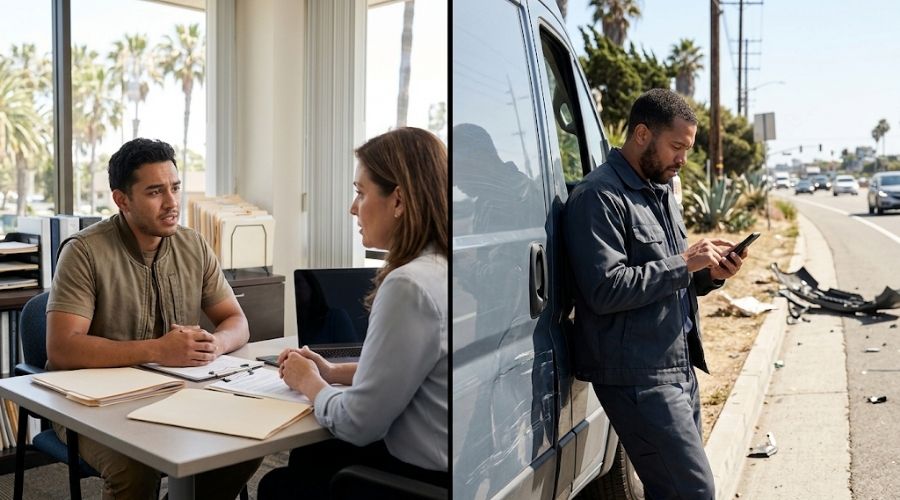
Why Two Drivers in Identical Crashes Get Different Answers
If you are an employee, workers’ compensation covers injuries that happen in the course of your work, without any fault or fight. If you are an independent contractor, workers’ comp generally does not apply to you at all. If you drive for an app, a separate framework created by California voters governs what you receive.
That is the whole map. Everything else is detail about which box you occupy.
The complication is that the box is not always the one written on your paperwork. Classification is a legal question about how the work actually operates, and companies have strong financial reasons to answer it in their own favor.
The Classification That Decides Everything
California generally treats a worker as an employee unless the hiring business can show otherwise, which is a meaningful shift from how these disputes used to run. Signing a document that calls you an independent contractor does not settle it, and neither does receiving a 1099 instead of a W-2.
What matters is the reality of the arrangement. Who controls how the work is done, whether the work is central to the company’s actual business, and whether you genuinely operate an independent enterprise serving other customers.
This scenario is why misclassification is worth taking seriously rather than accepting at face value. A warehouse driver told them they are a contractor who drives a company-marked vehicle on a company-assigned route with company-set delivery windows, describing something that looks like a striking deal, like employment.
If that description fits you, the question of whether you are entitled to workers’ comp is open rather than closed. It is worth having someone look at it before you accept that you have no claim.
If You Are an Employee, Coverage Follows You Onto the Road
For employees, workers’ compensation covers injuries that occur while they are working. For a driver, the road is the workplace, so a crash during a delivery route generally counts as a work-related injury, regardless of who caused it.
There is a wrinkle worth knowing. California’s general rule excludes ordinary commuting to and from a fixed workplace, but the exceptions are enormously important for drivers. When you are running a route, making a delivery, or using your vehicle as a required part of the job, you are typically working, not commuting.
Loading and unloading injuries fall in the same category. Back and shoulder injuries from lifting freight, falls off a liftgate or out of a trailer, and injuries at a customer’s dock are all part of the job for a driver.
The state also warns that waiting more than thirty days to report a work injury can jeopardize benefits, and drivers are especially prone to letting that slide because they finish the route first and think about the pain later.
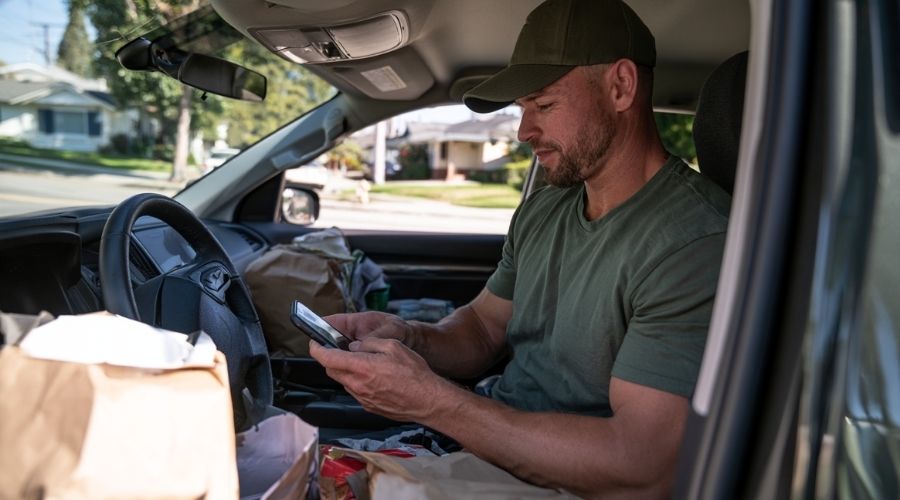
If You Drive for an App, You Are in a Different System
Proposition 22, approved by California voters, classifies app-based drivers for rideshare and delivery platforms as independent contractors and substitutes an occupational accident insurance arrangement for workers’ compensation. The California Supreme Court upheld that measure in July 2024 in the Castellanos case, so the framework remains in place.
Understand what that means practically. You are not in the workers’ compensation system, which means the benefits, the procedures, and the dispute process are all different from what an employee driver receives.
Analysts comparing the two systems have pointed to real gaps in the Prop 22 model, including limits on medical coverage, the absence of permanent disability benefits, and no comparable retraining benefit, along with a less developed process for resolving disagreements about a claim.
There is one detail that decides many of these claims: whether you were online and engaged in the app at the time of the injury. Platforms treat that status as the trigger. Preserving your screenshots and trip records immediately, rather than relying on the platform to produce them later, is one of the most useful things an injured app driver can do.
The app decides what your injury is worth based on a status you may not be able to prove later.
The Claim Almost Every Injured Driver Also Has
Whichever system covers your injury, it is rarely the only avenue available after a crash, because someone else usually caused it.
A claim against the at-fault driver is a civil negligence case, entirely separate from workers’ comp or a platform claim. It reaches damages neither of those systems pays, including compensation for pain and the full scope of what the injury cost you.
The defendants are often larger than the driver who hit you. When someone causes a crash while working, their employer can be responsible for their conduct. Trucking companies, other delivery operations, and commercial fleets carry substantial coverage, and their vehicles frequently carry telematics data that settles disputes about speed and braking.
Non-driving injuries have third parties too. A shipper that loaded a trailer improperly, a dock owner who let a plate deteriorate, a lift manufacturer, or a property owner whose lot was dangerous can all be responsible for what happened to you.
One caution: if workers’ comp paid your benefits, your employer’s insurer generally has a right to be reimbursed out of a civil recovery. That right is negotiable, and the two cases need to be run as one strategy rather than separately.
The Coverage Nobody Tells You to Check
Look at your auto policy. Uninsured and underinsured motorist coverage protects you when the person who caused the crash has no insurance or not enough, and California insurers must offer it, though drivers can waive it in writing.
Many people waive it to save money and forget they did. Then they get hit by someone carrying bare minimum coverage or by someone who leaves the scene and discovers the gap at the worst possible moment.
Medical payments coverage is the other one worth checking. It pays for immediate medical care regardless of who was at fault, which can matter enormously in the weeks before any liability claim resolves.
For drivers, there is an added question: whether the vehicle you drive is covered by a commercial policy, your personal policy, or a hybrid endorsement. Personal auto policies commonly exclude delivery use, which is a discovery nobody wants to make after a crash.
What to Do From the Roadside Onward
Report the injury the same day to your employer in writing or through the platform’s in-app process, and keep proof that you did. Then call for a police response, because an official report anchors the facts before stories change.
Photograph everything: both vehicles, the position of the wreck, the street and signals, and any company markings on the other vehicle. If the other driver was working, note the company name, the truck number, and the plate.
Get witness contact details immediately. On a delivery route, witnesses are strangers who will be impossible to find in a week.
Then see a doctor, even if you feel functional. Adrenaline hides a great deal, and a gap between the crash and the first medical visit is the first thing an adjuster will use against you.
Be aware of the deadlines. Report the work injury promptly for the comp side, and remember that a civil claim against an at-fault driver generally must be filed within two years of the injury in California, with a much shorter window when a public entity is involved.

Conclusion
Two takeaways. Your injury claim as a delivery driver depends less on what happened in the crash than on how your work is classified, and that classification is a legal question rather than whatever your paperwork says. And no matter which system covers you, the claim against whoever caused the crash is usually where the real compensation lives.
If you were hurt driving for a living and you are getting conflicting answers about who covers you, that is worth a free conversation. Oracle Law Firm handles car accident and personal injury claims alongside comp claims for drivers across Orange County.
Been in an accident or hurt on the job? You don’t have to navigate insurance companies alone. Oracle Law Firm fights to get you the compensation, control, and clarity you deserve.
Get a Free Consultation or call 888.597.4099.
This article is for general information only and is not legal advice. Every case turns on its facts, and outcomes depend on the specific circumstances involved. Speak with an attorney about your situation.
Frequently Asked Questions
Does workers’ comp cover me if I crash while making a delivery?
If you are an employee, injuries that occur while you are performing your job duties, including driving a route or making a delivery, are generally covered. The ordinary commute to and from a fixed workplace usually isn’t covered, but running a route counts as work, not commuting. Report the injury promptly, since delay can jeopardize benefits.
Are app-based delivery drivers covered by workers’ compensation in California?
Generally no. Proposition 22 classifies app-based drivers as independent contractors and provides an occupational accident insurance framework instead, and the California Supreme Court upheld that measure in 2024. Whether a specific injury is covered often turns on whether you were online and engaged in the app, so preserve your trip records.
What if my employer says I am an independent contractor?
That label is not automatically correct. California generally presumes a worker is an employee unless the hiring business can establish otherwise, and the analysis looks at how the work actually operates rather than what a contract says. If you drive an assigned route on company terms, it is worth having your classification reviewed.
Can I sue the driver who hit me if workers’ comp is covering my treatment?
Yes. A claim against an at-fault driver is a separate civil case that can reach damages workers’ comp does not pay, such as compensation for pain and suffering. Your employer’s insurer generally has a right to reimbursement from that recovery, so the two cases should be coordinated rather than handled separately.
What if the driver who hit me had no insurance?
Uninsured and underinsured motorist coverage on your policy may apply. California insurers are required to offer this coverage, though drivers can decline it in writing, so check your declarations page. There are also notice requirements for these claims, which makes prompt reporting to your insurer important.