Suffering a burn injury in Californiacan turn your life upside down in seconds. From painful medical treatments to overwhelming bills and long-term scarring, the impact is often devastating. But if your injury was caused by someone else’s negligence, you may be entitled to significant compensation—far more than insurance companies want you to know.
We’ll break down your legal rights, compensation options, and what it really takes to win a burn injury lawsuit in California so you can protect yourself and your future.

Understanding Burn Injury Lawsuits in California
A serious burn injury can change your life in an instant. Beyond the physical pain, victims often face extensive medical treatments, surgeries, infections, scarring, emotional trauma, and long-term disability. When a burn injury is caused by negligence—whether from a car accident, workplace incident, defective product, or unsafe property—you have the right to pursue compensation under California personal injury laws.
California provides strong legal protections for burn victims, but winning a claim requires evidence, medical documentation, and strategic legal action.
Common Causes of Burn Injuries in California
Burns happen across many environments, but negligence is often a major factor. Common causes include:
- Car accidents (fuel fires, explosions, airbag burns)
- Workplace accidents (chemical exposure, electrical burns, industrial fires)
- Residential or commercial fires
- Defective products (batteries, electronics, appliances)
- Gas explosions
- Hot liquid or steam injuries
- Restaurant accidents (scalding spills, kitchen burns)
- Construction site incidents
Identifying the cause is crucial because it determines who is liable—an employer, manufacturer, property owner, driver, or multiple parties.
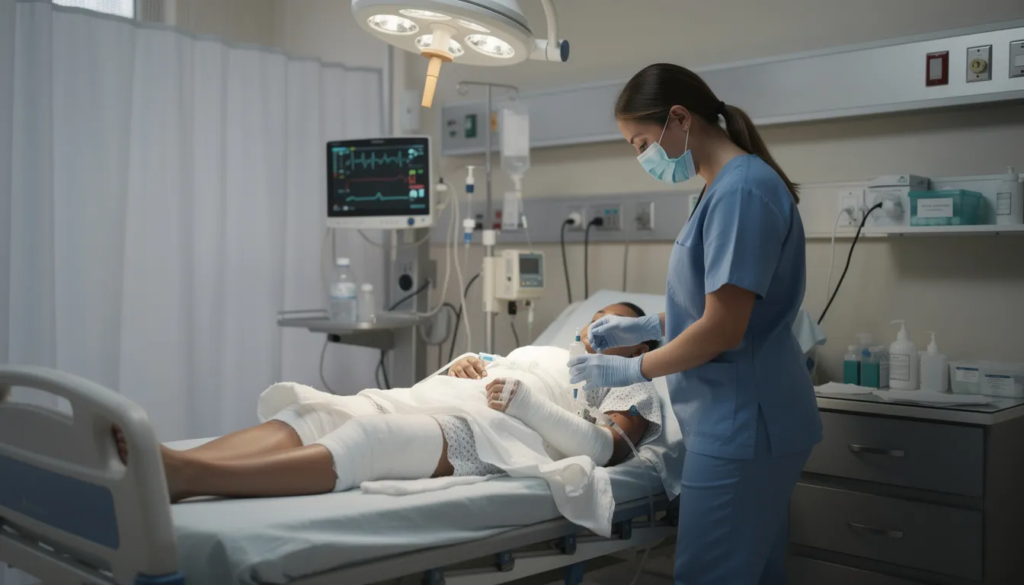
Types and Severity of Burn Injuries
Medical classification systems used by California courts and insurance companies categorize burns by depth and severity, directly impacting compensation calculations and treatment requirements.
First-Degree Burns (Superficial)
First-degree burns affect only the outer layer of skin (epidermis), presenting with redness, pain, and minor swelling without blistering. These burns typically heal within 3-7 days without permanent scarring, though they can still justify legal action when covering large areas or resulting from clear negligence.
Typical settlement ranges for first-degree burns in California span $1,000 to $5,000, depending on the affected area and treatment required. While these injuries may seem minor, extensive first-degree burns can require significant medical treatment and time off work, supporting higher compensation demands.
Examples include sunburns from defective sunscreen products, brief contact with hot surfaces due to inadequate warnings, and chemical exposure from improperly labeled cleaning products. Even minor burns can justify substantial settlements when they affect the face or hands, areas critical to professional and social functioning.
The key factor in first-degree burn cases is often the defendant’s conduct rather than injury severity. Clear negligence or willful misconduct can result in settlements exceeding typical ranges, particularly when punitive damages are available under California Civil Code Section 3294.
Second-Degree Burns (Partial Thickness)
Second-degree burns involve both the epidermis and dermis, characterized by severe pain, blistering, and a wet or shiny appearance that distinguishes them from first-degree burns. Recovery typically requires 2-6 weeks with potential for permanent scarring and skin discoloration.
California settlement ranges for second-degree burns typically span $25,000 to $100,000, though amounts can be significantly higher when scarring affects visible areas or causes functional limitations. The location and extent of scarring dramatically influence compensation, with facial burns commanding premium valuations.
Long-term complications from second-degree burns include pigmentation changes that may never fully resolve, keloid scars that grow beyond the original burn area, and contractures that limit joint mobility. These permanent effects support claims for ongoing medical treatment and diminished quality of life.
Physical therapy and occupational therapy often become necessary when second-degree burns affect joints or large muscle groups. California courts recognize these ongoing treatment needs and factor them into both economic and non-economic damage calculations.
Third-Degree Burns (Full Thickness)
Third-degree burns destroy all skin layers, often extending into subcutaneous fat and presenting with a white, brown, or charred appearance. Paradoxically, these burns may initially cause less pain than second-degree burns due to nerve ending destruction, though surrounding areas typically cause severe pain.
California settlement ranges for third-degree burns typically start at $100,000 and can exceed $2 million depending on the total body surface area affected and location. These burns almost always require skin grafts, multiple surgeries, and extensive rehabilitation, creating substantial economic damages.
Required treatments include surgical excision of dead tissue, skin grafts harvested from unburned areas, and reconstructive surgery to restore function and appearance. Many patients require multiple procedures over several years, with some needing ongoing revisions throughout their lifetime.
Permanent disabilities from third-degree burns include mobility limitations from contractures, chronic neuropathic pain that may never fully resolve, and psychological trauma from disfigurement. These factors support substantial non-economic damage awards for pain and suffering, emotional distress, and loss of enjoyment of life.
Fourth-Degree Burns (Deep Full Thickness)
Fourth-degree burns extend beyond skin into muscle, bone, and internal organs, representing the most catastrophic burn injuries. These burns often require amputation and carry life-threatening complications including sepsis and organ failure.
California settlements for fourth-degree burns frequently exceed $1 million and often reach multi-million dollar amounts reflecting the catastrophic nature of these injuries. The combination of massive medical costs, permanent disability, and profound suffering justifies these substantial awards.
Life-threatening complications require immediate intensive care and may include respiratory failure from smoke inhalation, kidney failure from tissue breakdown, and overwhelming infection that can prove fatal. Survivors face lifetime care needs including prosthetics, home modifications, and ongoing psychological support.
Lifetime care needs for fourth-degree burn survivors include multiple reconstructive surgeries, prosthetic devices and their periodic replacement, home modifications for wheelchair accessibility, and comprehensive psychological counseling. Life care plans for these injuries routinely exceed $5 million in present value calculations.
California-Specific Burn Injury Laws and Regulations
California’s unique legal framework provides several advantages for burn injury victims compared to other states, including favorable limitation periods and comparative negligence rules.
Statute of Limitations (Code of Civil Procedure Section 335.1)
California provides a two-year statute of limitations for personal injury claims including burn injuries, measured from the date of injury occurrence. This deadline is absolute in most cases, making prompt legal consultation essential for preserving your rights.
Government claims require special attention under Government Code Section 911.2, mandating written notice within six months of the injury date when suing public entities. This includes claims against cities, counties, school districts, and public utilities, with strict procedural requirements that can bar otherwise valid claims.
The discovery rule provides limited exceptions when injuries weren’t immediately apparent, though burn injuries are typically obvious at the time of occurrence. More relevant exceptions include tolling provisions for minors and mentally incapacitated victims, extending their deadlines until reaching majority or regaining capacity.
Missing these deadlines typically bars any recovery regardless of case merit, making early attorney consultation critical. Oracle Law Firm emphasizes immediate case evaluation to ensure all procedural requirements are met and evidence is preserved while still available.
Comparative Negligence in California
California’s pure comparative negligence system represents one of the most favorable frameworks for burn injury victims nationwide. Unlike modified comparative negligence states that bar recovery when victims are 50% or more at fault, California allows recovery even at 99% fault levels.
Jury instruction methods for calculating damage reductions are straightforward: if you’re found 40% responsible for your burn injury and total damages are $500,000, your recovery equals $300,000. This calculation applies to all damage categories including medical expenses, lost wages, and pain and suffering.
The system’s impact on settlement negotiations and trial strategy is profound, as defendants cannot completely escape liability by proving victim fault. Instead, they must focus on damage minimization through fault allocation, often leading to more favorable settlements for injured parties.
Practical examples include workplace burn accidents where employees violated safety protocols but employers failed to provide adequate protection, or residential fires where tenants were negligent but landlords violated fire codes. Both parties’ fault gets allocated, but victims can still recover substantial compensation.
Workers’ Compensation vs. Third-Party Claims
California Labor Code provisions typically provide the exclusive remedy against employers for workplace burn injuries, limiting recovery to medical expenses, partial wage replacement, and modest disability benefits. However, significant exceptions allow additional third-party claims that can dramatically increase total recovery.
The exclusive remedy rule doesn’t apply to contractors working on the same job site, equipment manufacturers whose defective products caused burns, or property owners who created dangerous conditions. These third-party claims follow standard personal injury law without workers’ compensation limitations.
Coordination requirements ensure burn victims don’t receive double recovery for the same damages. Workers’ compensation liens must be satisfied from personal injury settlements, though skilled attorneys can often negotiate lien reductions that maximize net recovery for injured workers.
Some serious and willful employer misconduct may allow additional claims beyond workers’ compensation, such as when employers deliberately remove safety equipment or force employees to work in known dangerous conditions. These cases are rare but can result in substantial additional recovery.
Damages Available in California Burn Injury Cases
California law provides comprehensive damage recovery for burn injury victims, including both economic losses and non-economic suffering without statutory caps in most cases.
Economic Damages
Medical expenses represent the largest component of economic damages in severe burn cases, including emergency treatment, surgery, skin grafts, rehabilitation, and projected future care costs. California burn centers like UC Davis and USC Verdugo Hills provide specialized treatment that can cost hundreds of thousands of dollars for severe injuries.
Lost wages and diminished earning capacity calculations consider both immediate time off work and long-term career impacts from permanent disabilities or disfigurement. Vocational rehabilitation experts analyze how burn injuries affect victims’ ability to perform their previous jobs and what alternative employment options remain viable.
Documentation requirements for economic damages are strict, requiring medical records, employment history, tax returns, and expert testimony to establish both past losses and future projections. Life care planners provide detailed cost estimates for lifetime medical needs, while economists calculate present value of lost earning capacity.
Property damage claims may include personal belongings destroyed in fires, vehicle damage from explosions, and home modification costs for burn-related disabilities. These damages are often overlooked but can add substantial value to burn injury settlements.
Non-Economic Damages
Pain and suffering compensation in California recognizes that burn injuries are among the most painful medical conditions, involving excruciating initial treatment, repeated surgeries, and often chronic neuropathic pain that may never fully resolve. California juries consistently award substantial pain and suffering damages in severe burn cases.
Disfigurement and scarring damages receive special attention when burns affect visible areas, particularly the face, neck, and hands. California courts recognize that visible scarring affects employment opportunities, social relationships, and self-esteem, supporting significant non-economic awards even for burns that don’t cause functional limitations.
Loss of enjoyment of life encompasses the inability to participate in previously enjoyed activities due to physical limitations, chronic pain, or psychological trauma from the burn injury. This includes recreational activities, sports, hobbies, and social interactions that define quality of life.
Calculation methods used by California juries vary widely but often consider the victim’s age, the permanence of their injuries, and how the burns have affected their daily life. While there’s no mathematical formula, experienced attorneys understand the factors that influence jury attitudes and can effectively present these damages.
Punitive Damages (Civil Code Section 3294)
Punitive damages become available when defendants’ conduct involves oppression, fraud, or malice, requiring clear and convincing evidence of particularly egregious behavior. In burn injury cases, this might include deliberately ignoring known safety hazards or concealing burn risks from consumers.
Corporate liability requirements under California law demand evidence that managing agents ratified or authorized the misconduct, not just lower-level employees. This makes punitive damage claims more challenging but also more valuable when successful, as they signal systematic corporate wrongdoing.
California law doesn’t cap punitive damages in personal injury cases, though they must bear a reasonable relationship to compensatory damages. Recent California cases have affirmed punitive awards up to nine times compensatory damages in appropriate circumstances.
Examples of punitive-worthy conduct include manufacturers who knew their products caused burns but failed to warn consumers, landlords who repeatedly ignored fire hazard complaints, and employers who forced workers to bypass safety equipment to meet production quotas.

Settlement Amounts and Case Examples from California
Recent California burn injury cases demonstrate the substantial compensation available for severe burns while illustrating the factors that drive high-value recoveries.
Notable California Burn Injury Verdicts
A $4.2 million verdict for workplace chemical burns in Los Angeles County in 2023 involved a manufacturing worker who suffered third-degree burns over 40% of his body when a chemical storage tank ruptured due to poor maintenance. The jury found the employer failed to follow safety protocols and awarded substantial damages for future medical care and pain and suffering.
A $2.8 million settlement for an apartment electrical fire in San Francisco in 2022 compensated a family whose young child suffered severe burns when faulty wiring ignited their unit. The landlord had received multiple tenant complaints about electrical problems but failed to hire qualified electricians for repairs, leading to the tragic fire.
A $1.5 million recovery for defective space heater burns in Orange County in 2023 involved a product liability claim against a major manufacturer whose heater overheated and ignited nearby furniture. The victim suffered second and third-degree burns requiring multiple skin grafts and reconstructive surgeries.

Steps to Take After a Burn Injury in California
Immediate action following a burn injury can significantly impact both your medical recovery and legal rights under California law.
Emergency Medical Care
Call 911 immediately for serious burns and seek emergency treatment even if burns initially appear minor. Burn injuries can worsen rapidly, and delayed treatment often leads to complications that could have been prevented with prompt care.
California burn centers including UC Davis Regional Burn Center, USC Verdugo Hills Hospital Burn Center, and UCSF Fresno provide specialized treatment for severe burns. These facilities offer expertise that general hospitals may lack, potentially improving outcomes and supporting larger damage claims.
Document all medical treatment by obtaining copies of emergency department records, hospital charts, surgical reports, and diagnostic imaging. Complete medical documentation supports both treatment decisions and legal claims for damages.
Follow all physician recommendations for treatment, medication, and follow-up care. Failure to comply with medical advice can be used by defendants to argue comparative fault or failure to mitigate damages, potentially reducing your recovery.
Incident Documentation
Photograph burn injuries and accident scenes as soon as safely possible, as evidence can be lost quickly through cleanup or repairs. These photographs become crucial evidence for proving both liability and the extent of your injuries.
Identify and interview witnesses to obtain their contact information while memories are fresh. Witness testimony often proves critical in establishing how accidents occurred and whether defendants acted negligently.
Report workplace injuries to your employer and Cal/OSHA when applicable, creating official records that support your claims. These reports also trigger safety investigations that may reveal additional evidence of negligence or code violations.
Preserve all physical evidence including defective products, damaged clothing, and any equipment involved in the accident. Don’t discard anything until consulting with an attorney, as physical evidence often provides the strongest proof of defect claims.
Oracle Law Firm | Accident & Injury Attorneys | Make Pain Pay
When you suffer a burn injury in California, acting fast is critical. Contact Oracle Law Firm within 24–48 hours to protect your legal rights and ensure that vital evidence is preserved. Early attorney involvement helps prevent evidence loss, establish causation, and build a strong foundation for your claim from day one.
Avoid giving any recorded statements to insurance companies before speaking with our legal team. Adjusters are trained to ask questions that weaken your case and reduce your compensation. Oracle Law Firm prevents insurers from using your statements against you and handles all communication on your behalf.
Our attorneys also help you review all applicable insurance policies, including health insurance, auto coverage, renter’s or homeowner’s policies, and umbrella coverage. Burn injuries often trigger multiple sources of compensation, and proper coordination ensures you maximize every available benefit.
If your injuries prevent you from working, Oracle Law Firm will guide you in collecting employment records, pay stubs, tax returns, and wage documentation. Proving the financial impact of lost income strengthens your economic damage claim and helps secure the highest possible settlement.
Make Pain Pay—Oracle Law Firm is ready to fight for your rights, your recovery, and your future.
Frequently Asked Questions
How long do I have to file a burn injury lawsuit in California?
California provides a two-year statute of limitations for personal injury claims including burn injuries, starting from the date of injury. Government entity claims must be filed within six months under the California Tort Claims Act. Some exceptions apply for delayed discovery of injuries or when victims are minors. Missing these deadlines typically bars any recovery, making prompt legal consultation critical.
Can I still recover damages if I was partially at fault for my burn injury?
Yes, California follows pure comparative negligence, allowing recovery even if you’re 99% at fault. Your damages will be reduced by your percentage of responsibility as determined by a jury. For example, if you’re 30% at fault and damages are $100,000, you’d recover $70,000. This makes California more favorable to injured parties compared to modified comparative negligence states.
What makes California burn injury cases different from other states?
California has stricter product liability laws that favor consumers injured by defective products. The state’s pure comparative negligence system allows broader recovery opportunities. California OSHA requirements create additional liability theories for workplace burn cases. Higher cost of living and wages in California typically result in larger economic damage calculations.
How do workplace burn injuries interact with workers’ compensation in California?
Workers’ compensation typically provides the exclusive remedy against your employer for workplace burns. However, you can pursue third-party claims against contractors, equipment manufacturers, or property owners. You must coordinate workers’ comp benefits with any personal injury settlement to avoid double recovery. Some serious and willful employer misconduct may allow additional claims beyond workers’ compensation.
What should I expect during the settlement process for a burn injury case?
Simple burn cases may settle within 6-12 months, while complex cases can take 2-3 years. Your attorney will need to wait until you reach maximum medical improvement to fully value your claim. Insurance companies often make initial lowball offers, requiring skilled negotiation to achieve fair value. Most cases settle out of court, but having trial-ready attorneys like Oracle Law Firm increases settlement leverage.