California’s expanded move-over law took effect on January 1, 2026, extending protections to drivers approaching stationary vehicles displaying flashing hazard lights or other warning devices. If you need a freeway shoulder accident lawyer in Inland Empire, the other driver’s failure to move over or slow down may help support your claim. Get to safety, call 911, document the scene, and seek medical care. Most California personal injury lawsuits must be filed within two years, but exceptions and shorter deadlines may apply.
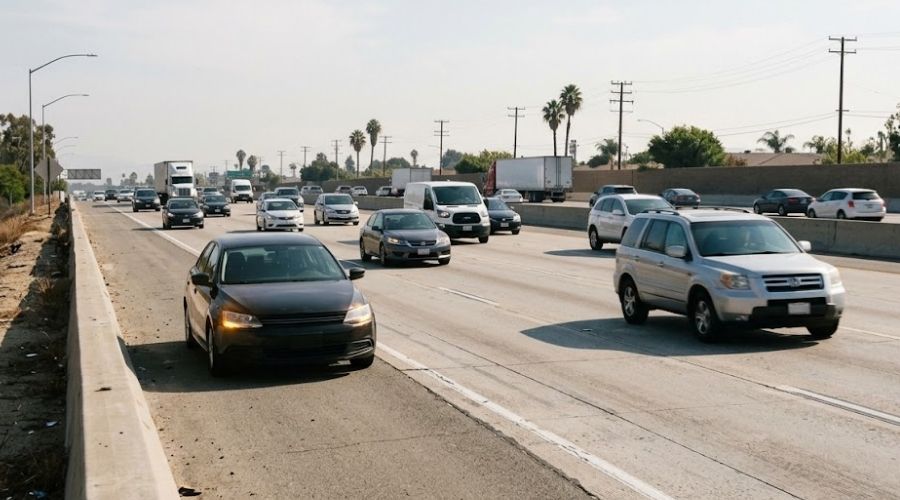
Your hazard lights are blinking. You are stopped on the I-15 near the Cajon Pass with a flat tire or stranded on the I-10 in Ontario. Trucks roar past just a few feet away. Then a driver fails to give you enough space, and everything changes.
If you were hit while stopped on a freeway shoulder, a freeway shoulder accident lawyer in the Inland Empire can help you understand your legal options. California’s expanded 2026 move-over law may be particularly relevant to your case.
Freeway shoulder accidents are frightening and can cause serious injuries. People may be standing outside their vehicles, checking a tire, waiting for roadside assistance, or sitting in a disabled car with little time to react. After a collision, an insurance company may argue that stopping on the freeway shoulder contributed to the crash.
That argument does not automatically make you responsible. California law requires approaching drivers to exercise due caution around qualifying stopped vehicles. Whether the other driver violated the law, and whether that violation contributed to your injuries, depends on the facts and available evidence.
Here is what California’s 2026 move-over law means for you, how liability may be established, and what to do after a freeway shoulder accident in the Inland Empire.
What to Do Right After a Freeway Shoulder Crash? Contact a Freeway Shoulder Accident Lawyer in Inland Empire
Quick take: Prioritize your safety, call 911, and get medical care. If you can safely do so, document your hazard lights, warning devices, and the positions of the vehicles involved. This evidence may help establish how the freeway shoulder accident occurred.
Your safety comes first. If you can move safely, get behind a protective barrier and away from moving traffic. Do not put yourself at risk to photograph the scene or retrieve belongings.
After a freeway shoulder accident, take these steps when it is safe:
- Call 911. Report the collision and request emergency assistance when needed. The California Highway Patrol (CHP) handles many freeway collisions.
- Get medical attention. Seek prompt evaluation even if you initially feel fine. Some injuries may not become apparent immediately.
- Photograph your hazard lights and warning devices. If it is safe, document flashing lights, reflective triangles, cones, or other devices you were using.
- Document the scene. Capture vehicle damage, road markings, skid marks, debris, weather conditions, and vehicle positions if you can do so safely.
- Collect witness information. Ask witnesses for their names and contact details, including other motorists and tow operators.
- Keep roadside records. Save tow receipts, roadside assistance confirmations, and repair documents that may help establish when and where you stopped.
- Preserve medical and financial records. Keep medical bills, treatment records, and documents showing time missed from work.
If you later consult a freeway shoulder accident lawyer in the Inland Empire, these records may help the attorney evaluate liability and damages.
What California’s Move-Over Law Requires in 2026
Quick take: Effective January 1, 2026, California expanded its move-over law to cover stationary vehicles displaying flashing hazard lights or other warning devices, including cones and flares. Approaching drivers must exercise due caution and, when passing in an adjacent lane, change to a nonadjacent lane if practicable and safe. If that maneuver is unsafe or impracticable, they must slow to a reasonable and prudent speed.
The change came from AB 390, which amended California Vehicle Code section 21809. The California DMV lists the expansion among the laws taking effect on January 1, 2026.
Before the expansion, the law focused on certain emergency vehicles, tow trucks, and marked highway maintenance vehicles. The amended law also covers other stationary vehicles displaying flashing hazard lights or another qualifying warning device.
The expanded law is especially relevant to drivers stranded by a breakdown, flat tire, or collision on a busy Inland Empire freeway.
Who the Law May Protect
- Everyday motorists stopped with a breakdown or flat tire and displaying qualifying warning lights or devices.
- Rideshare and delivery drivers whose vehicles are stopped on the roadside with the required warnings.
- Tow operators and highway maintenance crews covered by the law’s existing provisions.
- Other stranded motorists whose stationary vehicles display flashing hazard lights or qualifying warning devices.
What Approaching Drivers Must Do
- Move over when practicable and safe. Change into an available lane that is not immediately adjacent to the stopped vehicle, when permitted by law and traffic conditions.
- Slow down when necessary. If changing lanes would be unsafe or impracticable, reduce speed to a reasonable and prudent level that is safe for existing conditions.
- Approach with due caution. Account for traffic, weather, road conditions, and the people who may be near the stopped vehicle.
The law does not require a driver to make an unsafe lane change. It does require the driver to follow the applicable safety requirements.
If your vehicle was displaying the required warnings, the approaching driver’s response may be an important part of your accident claim.
What does California’s move-over law require in 2026?
Under AB 390, drivers approaching any stationary vehicle with hazard lights or warning devices must either move over a lane when it is safe to do so or slow to a reasonable and safe speed if they cannot move over. Before 2026, the rule mainly applied to emergency, tow, and highway maintenance vehicles.
Can I get compensation if I was hit while stopped on the shoulder?
Often, yes. If the other driver failed to move over or slow down, that violation can create a presumption of negligence under California law. The insurer may argue you share some blame, but California’s comparative fault rules still allow recovery reduced by your share of fault.
Who is liable if a truck hit my car on the freeway shoulder?
The truck driver and the trucking company may both be responsible. Trucking companies can be liable for their drivers’ conduct and for problems like poor training or unsafe schedules. Many interstate carriers also carry higher insurance limits than ordinary drivers.
What should I do after a freeway shoulder accident in the Inland Empire?
Get to safety, call 911 so the CHP can respond, and get medical care. Photograph your hazard lights, warning devices, and the scene, and collect witness information. Avoid giving a recorded statement to the other driver’s insurer before speaking with a lawyer.
How long do I have to file a claim after a shoulder crash in California?
Most personal injury lawsuits must be filed within two years of the injury. If a government agency like Caltrans shares responsibility, you may need to file a formal claim within six months. Talking to an attorney early helps protect both deadlines.