If you were hurt in an e-bike accident in Orange County, get medical care, document the scene, and understand your legal rights before discussing the crash with an insurance company. Fault depends on what happened, not simply on who was riding the e-bike. Riders hit by cars and pedestrians hit by e-bikes may both have personal injury claims. Whether the vehicle was a legal electric bicycle or an e-moto can also affect liability and insurance coverage. In most California personal injury cases, you have two years to file a lawsuit, although important exceptions apply.
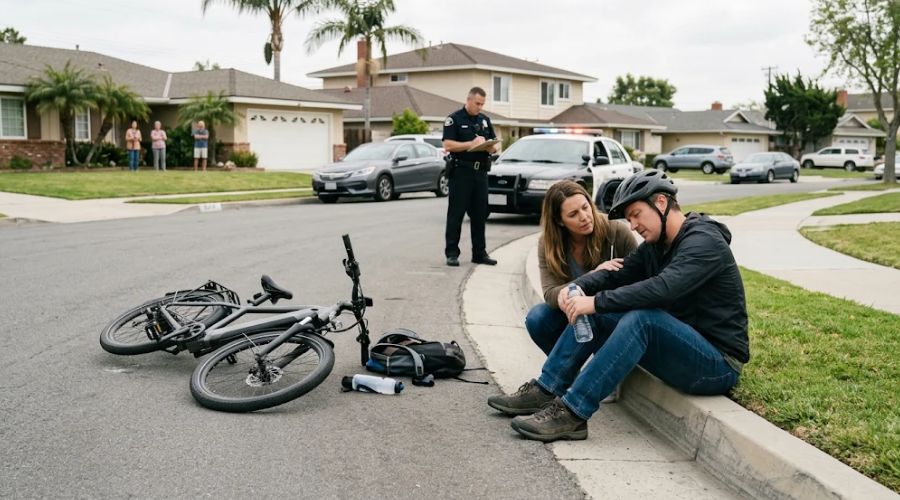
You are sitting on the curb on Pacific Coast Highway. Your wrist is throbbing, your back wheel is bent, and the driver who turned in front of you is already telling the officer you “came out of nowhere.”
Or maybe you were walking near a school in Irvine when a teenager on an electric bike slammed into you. Either way, you are hurting, and you are wondering what happens next.
If you are searching for an e-bike accident lawyer in Orange County, you are not alone. Electric bicycles have become increasingly common throughout Southern California, bringing new safety concerns, legal questions, and insurance challenges.
Cities are introducing new restrictions, California has updated its electric bicycle laws, and insurance companies may question who was responsible for an accident.
Take a breath. You have rights, whether you were riding an e-bike or were the person who got hit. This guide explains what to do after an e-bike accident, who may be legally responsible, how California e-bike laws affect your claim, and how to protect yourself when dealing with insurance companies.
What to Do Right After an E-Bike Accident in Orange County
Quick take: Get to safety, call 911, and seek medical care, even if you initially feel okay. Document the accident scene before conditions change, collect witness information, and preserve your e-bike and helmet. What you do immediately after an accident can affect your health and your potential personal injury claim.
The moments after an e-bike crash are chaotic. Adrenaline can temporarily mask serious injuries, including concussions, fractures, and internal injuries.
A prompt medical evaluation helps protect your health and creates medical documentation connecting your injuries to the accident.
If you have been involved in an electric bike accident in Orange County, consider taking these steps:
- Call 911 and request a police report. Report the accident, particularly if someone is injured or property is damaged.
- Get medical attention. Do not assume you are fine simply because you can stand or walk after the crash.
- Photograph everything. Capture the e-bike, other vehicles, road conditions, traffic signs, bicycle lanes, visible injuries, and the surrounding area.
- Collect witness information. Get names and phone numbers from people who saw the accident.
- Preserve the e-bike. Avoid repairing, modifying, or disposing of it before its condition has been documented.
- Keep your helmet. A cracked or damaged helmet may provide important evidence.
- Preserve digital evidence. Save photographs, dashcam footage, security camera information, and relevant electronic records.
- Be careful with insurance companies. Avoid giving a recorded statement or accepting a settlement before understanding your rights and the potential value of your injuries.
If you were hit by a car while riding an electric bicycle, or an e-bike rider struck you as a pedestrian, the evidence collected immediately after the accident may help establish what happened and who was responsible.
E-Bike or E-Moto? Why the Label Changes Your Claim
Quick take: California recognizes three classes of legal electric bicycles. However, some vehicles marketed as e-bikes may actually fall into another legal vehicle category. The distinction can affect applicable traffic laws, insurance coverage, and liability after an accident.
California Vehicle Code section 312.5 defines an electric bicycle as a bicycle equipped with fully operable pedals and an electric motor that does not exceed 750 watts.
California recognizes three e-bike classifications:
- Class 1: Pedal-assist only. The motor stops providing assistance when the bicycle reaches 20 mph.
- Class 2: Includes a throttle that can propel the bicycle without pedaling. Motor assistance stops at 20 mph.
- Class 3: Pedal-assist only, with assistance stopping at 28 mph. The bicycle must have a speedometer, and riders must be at least 16 years old.
These classifications matter because California applies different rules to different types of electric vehicles.
When an E-Bike May Actually Be an E-Moto
Some electric two-wheel vehicles marketed as e-bikes do not meet California’s legal definition of an electric bicycle.
For example, a vehicle may have:
- No manufacturer-provided operable pedals.
- A motor exceeding the permitted e-bike power limit.
- Modifications that take it outside the legal e-bike classification.
- Features that place it within another motor vehicle category.
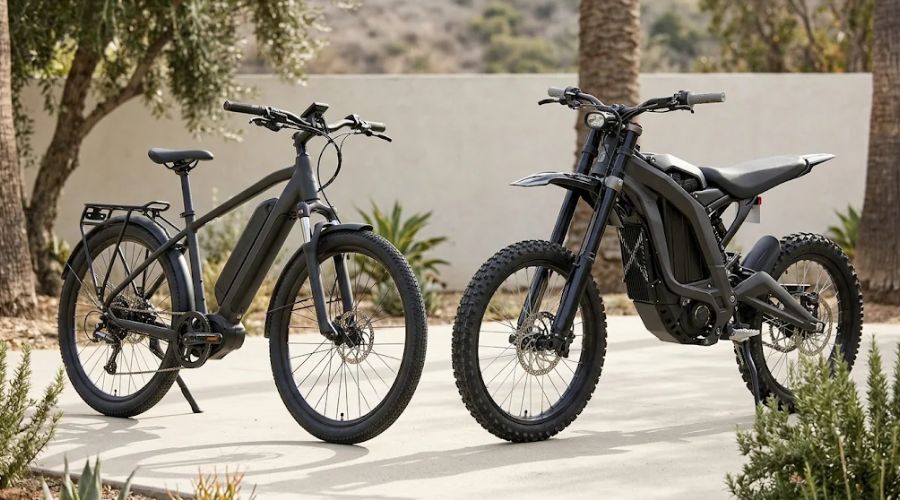
California also introduced a specific definition for off-highway electric motorcycles, or e-motos, under Senate Bill 586, effective January 1, 2026.
These vehicles are treated as off-highway motor vehicles and are subject to applicable registration and operating requirements. They are not simply another class of electric bicycle.
The exact classification depends on the vehicle’s design and characteristics, not just its marketing description.
Why Vehicle Classification Matters After an Accident
The type of electric vehicle involved can affect the legal issues surrounding a crash.
For example:
- Different vehicle classifications can involve different operating restrictions.
- The rider may have violated applicable traffic or vehicle laws.
- Insurance coverage may depend on the vehicle’s legal classification and the policy language.
- The vehicle’s modifications may become relevant evidence in determining liability.
If an e-moto or another improperly classified electric vehicle caused your injuries, an investigation may need to examine its specifications, modifications, ownership, and applicable insurance policies.
What the vehicle actually is matters more than what the box called it.
Who Is at Fault in an E-Bike Crash?
Quick take: Anyone whose negligence contributed to an accident may potentially be responsible. That could include a driver, an e-bike rider, a property owner, a vehicle manufacturer, or a government agency. California follows a pure comparative negligence system, meaning you may still recover compensation even if you share some responsibility.
Drivers cause many e-bike crashes, often because they misjudge how quickly an electric bicycle is approaching or fail to recognize a cyclist in their blind spot.
Common examples include:
- Left-turn accidents: A driver turns across the path of an approaching e-bike rider.
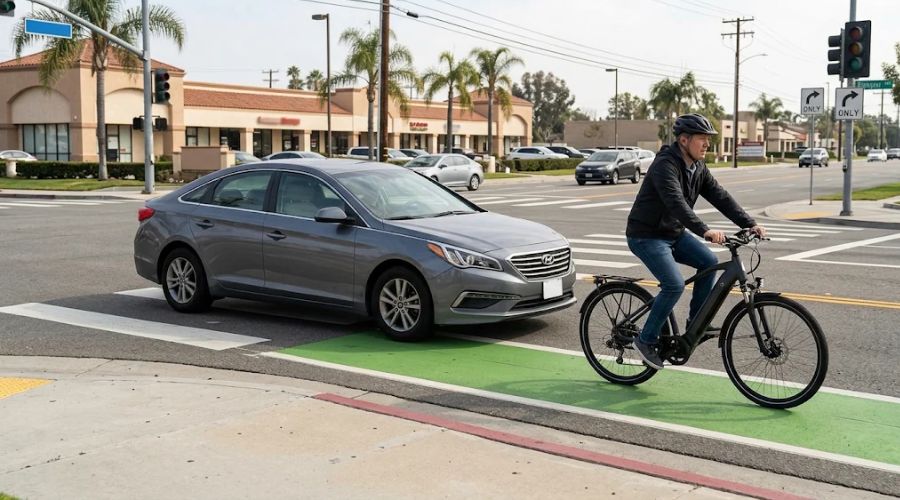
- Right-hook accidents: A driver turns right across a bicycle lane or the path of a cyclist.
- Dooring accidents: Someone opens a parked vehicle’s door into an approaching cyclist.
- Unsafe passing: A driver passes an electric bicycle without leaving sufficient space.
- Failure to yield: A driver fails to give a cyclist the required right of way.
- Distracted driving: A driver looking at a phone or other distraction fails to notice an approaching rider.
However, drivers are not automatically responsible for every electric bicycle accident.
An e-bike rider may also be liable if careless riding, excessive speed, failure to yield, or another unsafe action caused the collision.
California’s Pure Comparative Fault Rule
California follows a pure comparative negligence system.
This means an injured person may recover damages even if they were partially responsible for the accident. Their compensation is reduced according to their percentage of fault.
For example, if your damages total $100,000 and you are found 20% responsible, your potential recovery would be reduced to $80,000.
Insurance companies may investigate your speed, riding behavior, helmet use, and compliance with traffic laws to argue that you contributed to the accident.
However, an allegation of partial fault does not automatically eliminate your right to compensation.
When Parents Can Be Responsible
If a minor causes an e-bike accident, the parents may potentially face liability in certain circumstances.
Under California Civil Code section 1714.1, a parent or guardian with custody and control of a minor may be held liable for certain damages resulting from the minor’s willful misconduct, subject to statutory requirements and adjusted liability limits.
Parents may also face separate liability for their own negligence.
For example, an investigation may examine whether a parent knowingly provided an inappropriate or unlawfully modified electric vehicle to a child who could not safely operate it.
However, parental liability is not automatic simply because a minor caused an accident. The specific conduct, applicable law, and available evidence matter.
Hit by an E-Bike Rider? You May Still Have a Claim
Quick take: Yes. If an electric bicycle rider hits you while you are walking or riding another bicycle, you may have a personal injury claim against the rider. Depending on the circumstances, other parties and insurance policies may also be involved.
E-bike accidents do not only injure cyclists.
Pedestrians can suffer serious injuries when electric bicycle riders travel too quickly, fail to yield, or ride unsafely through crowded areas.
These incidents can occur on:
- Sidewalks and shared pedestrian paths.
- Beach boardwalks.
- School entrances and surrounding streets.
- Neighborhood intersections.
- Public parks and bicycle paths.
Older adults may face particularly serious consequences from falls and collisions, including hip fractures and traumatic brain injuries.
If you or a loved one suffered a head injury, our brain injury attorneys can help you understand the potential long-term costs and legal considerations associated with your injuries.
Who Pays If an E-Bike Rider Hits a Pedestrian?
Determining who pays for an e-bike pedestrian accident depends on the facts and available insurance coverage.
Potential sources of compensation may include:
- The rider’s homeowner’s insurance: Some policies may provide personal liability coverage, depending on their exclusions and conditions.
- The rider’s renter’s insurance: Certain policies may provide coverage for qualifying accidents involving an electric bicycle.
- A parent’s insurance policy: Coverage may be available when a minor causes an accident, depending on the policy and circumstances.
- The rider personally: An injured person may pursue a claim against the responsible individual.
- Other applicable insurance: If the vehicle is legally classified as a motor vehicle, additional insurance questions may arise.
Many homeowner’s and renter’s insurance policies contain exclusions for certain motorized vehicles. Coverage is not guaranteed simply because the accident involved an electric bicycle.
The exact policy language and legal classification of the vehicle must be examined.
If you were hit by an electric bicycle while walking, do not assume that you have no legal options simply because the rider does not have traditional auto insurance.
New 2026 E-Bike Rules and Orange County Crackdowns
Quick take: California’s 2026 electric bicycle rules include a requirement for a rear red reflector or qualifying rear red light during all hours of operation. Orange County communities also have local restrictions that may affect where and how certain e-bikes can be operated.
California’s e-bike regulations have continued to evolve as electric bicycle use increases.
One important statewide change involves Assembly Bill 544.
California’s AB 544: Rear Reflector Requirements
Effective January 1, 2026, AB 544 requires electric bicycles to have a red reflector or a solid or flashing red light with a built-in reflector on the rear during all hours of operation.
Previously, this requirement generally applied during darkness.
The change is relevant to electric bicycle safety and may become part of an investigation following an accident.
However, a violation of an equipment requirement does not automatically establish liability. The circumstances and connection between the violation and the accident must be evaluated.
Other California and Orange County Developments
Other developments also affect e-bike riders and communities.
Off-highway electric motorcycles: Senate Bill 586 introduced a specific legal definition for off-highway electric motorcycles beginning January 1, 2026. These vehicles are subject to off-highway vehicle requirements rather than ordinary e-bike rules.
Orange County regulations: Local requirements may differ depending on whether someone is riding on a public road, a city-maintained path, a county bikeway, or park property.
OC Parks restrictions: Orange County permits certain e-bike classes on designated regional paved bikeways while imposing restrictions on other motorized vehicles and trails.
City-specific rules: Communities such as Irvine, Huntington Beach, Garden Grove, and Fullerton may have additional restrictions or enforcement measures. The applicable ordinance should be checked for the location and date of the accident.
School-related restrictions: School districts may adopt their own policies governing e-bike use on school property and student access.
Why Local E-Bike Regulations Matter in an Accident Claim
A traffic or equipment violation may become relevant evidence when determining whether someone acted negligently.
For example, an investigation may examine:
- Whether the rider was operating the correct vehicle classification.
- Whether the rider was permitted to use the particular roadway or path.
- Whether required safety equipment was present.
- Whether the rider violated an applicable speed restriction.
- Whether a local ordinance applied at the accident location.
Orange County has multiple cities, local jurisdictions, and public agencies. The regulations governing an accident in Irvine may differ from those applicable to an accident in Huntington Beach or Garden Grove.
A thorough e-bike accident investigation should identify the precise location and applicable rules rather than assume that every Orange County community follows identical regulations.
A broken safety rule may be relevant evidence of negligence, but it does not automatically establish who caused the accident.
How Insurance Companies Fight E-Bike Accident Claims
Quick take: Insurance companies may investigate your riding behavior, the type of electric bicycle involved, and your injuries to reduce their financial exposure. Understanding the claims process can help you avoid making statements or decisions that negatively affect your case.
After an electric bicycle accident, an insurance adjuster may contact you to request information about what happened.
While some questions may be legitimate, remember that the insurer is evaluating its potential financial responsibility.
Common issues raised during e-bike accident investigations include:
“You weren’t wearing a helmet.”
An insurer may argue that your failure to wear a helmet contributed to your injuries.
However, that does not automatically excuse another person’s negligence. The relevance of helmet use depends on the facts, applicable law, and the relationship between helmet use and the injuries claimed.
“You were going too fast.”
Insurance companies may question your speed, especially when an accident involves a Class 1, Class 2, or Class 3 electric bicycle.
The actual speed, road conditions, applicable speed restrictions, and actions of everyone involved should be investigated.
“Your bike was modified.”
An insurer may argue that the vehicle was not a legally classified e-bike because it had been modified or exceeded applicable specifications.
The vehicle’s motor, pedals, speed capabilities, and other characteristics may become important evidence.
A quick, low settlement offer.
An early settlement may arrive before you understand the full extent of your injuries, treatment requirements, or potential future medical expenses.
Accepting a settlement generally involves giving up certain rights to pursue additional compensation for the same claim.
A recorded statement.
An adjuster may ask you to describe the accident in detail.
Your statements could later be used to challenge your version of events or argue that you contributed to the collision.
You are not automatically required to give the other driver’s insurance company a recorded statement. However, your own policy may contain separate reporting and cooperation requirements.
Before making decisions about an insurance claim, understand your obligations and consider getting legal advice.
How Long You Have to File an E-Bike Accident Claim in Orange County
Quick take: Most California personal injury lawsuits must be filed within two years of the injury. However, claims involving a government agency may require an administrative claim within six months. Other exceptions can affect the applicable deadline.
Deadlines are especially important in electric bicycle accident cases.
Waiting too long may affect your ability to pursue compensation, even when you have evidence that another person caused your injuries.
Here are some important California deadlines to understand.
Two Years for Most Personal Injury Lawsuits
Under California Code of Civil Procedure section 335.1, most personal injury lawsuits must be filed within two years of the injury.
This deadline commonly applies to negligence claims involving:
- A driver who hits an electric bicycle rider.
- An e-bike rider who injures a pedestrian.
- A cyclist injured because another person acted negligently.
- Other accidents involving bodily injuries caused by someone else’s wrongful conduct.
However, certain exceptions may affect when the deadline begins or how much time an injured person has.
Six Months for Many Claims Against Government Agencies
If a government agency may be responsible for an accident, a shorter administrative deadline may apply.
For example, a dangerous roadway condition, defective public bicycle path, or missing traffic sign may raise questions about government liability.
Under California Government Code section 911.2, claims involving personal injury generally must be presented to the appropriate public entity within six months of accrual.
This is an administrative claim requirement, not simply a six-month deadline for filing a lawsuit.
If the government agency rejects the claim, a separate deadline generally applies to filing a lawsuit.
Special Rules for Minors
Claims involving injured children may be subject to different statute-of-limitations rules.
However, the rules governing minors do not necessarily eliminate or extend every government claim deadline.
For this reason, parents should not assume that waiting until a child becomes an adult is always an option.
Why You Should Act Early
Even when you have time remaining under the applicable statute of limitations, starting an investigation early can help preserve important evidence.
For example:
- Traffic and security camera footage may be deleted.
- Witnesses may become difficult to locate.
- Damaged vehicles may be repaired or discarded.
- Road conditions may change.
- Electronic records may become harder to obtain.
If you were injured in an e-bike accident in Orange County, an experienced personal injury attorney can help identify potential claims, investigate liability, and determine which deadlines apply.
The Bottom Line
E-bike accidents in Orange County raise increasingly complicated questions about vehicle classifications, traffic regulations, insurance coverage, and personal injury liability.
Whether you were hit while riding an electric bicycle or injured by an e-bike rider as a pedestrian, your potential claim depends on the facts, the type of vehicle involved, the applicable laws, and the available evidence.
You may be entitled to compensation for medical expenses, lost income, pain and suffering, and other legally recoverable losses.
An experienced e-bike accident lawyer in Orange County can investigate the collision, identify potentially responsible parties, examine applicable insurance coverage, and help you understand your legal options.
Been in an accident or hurt on the job? You don’t have to navigate insurance companies alone.
Oracle Law Firm fights to get you the compensation, control, and clarity you deserve.
Get a Free Consultation or call 888.597.4099.
Frequently Asked Questions
What should I do after an e-bike accident in Orange County?
Call 911, get medical care, and document the accident scene with photographs and witness information. Preserve your electric bicycle and helmet as evidence, and avoid giving a recorded statement to another party’s insurance company before understanding your rights. A consultation with a personal injury attorney can help you evaluate your next steps.
Who pays if a car hits me while I’m on an e-bike?
If a driver caused the accident, their auto insurance may be the primary source of compensation. Depending on the circumstances and your policy, your own uninsured or underinsured motorist coverage may also be relevant. California’s comparative negligence rules generally allow you to pursue compensation even if you share some responsibility for the collision.
Can I file a claim if an e-bike rider hit me as a pedestrian?
Yes. If an electric bicycle rider negligently caused your injuries, you may have a personal injury claim against that rider. Depending on the circumstances, other parties, including a parent or guardian, may also face liability. Homeowner’s or renter’s insurance may provide coverage, but policy exclusions and conditions must be reviewed.
What is the difference between an e-bike and an e-moto in California?
A legal California e-bike must have fully operable pedals and an electric motor that does not exceed 750 watts. It must also meet the requirements for Class 1, Class 2, or Class 3 classification. An off-highway electric motorcycle is a separate vehicle category under California law. The legal classification can affect operating restrictions, liability, and insurance considerations following an accident.
How long do I have to file an e-bike accident claim in California?
Most personal injury lawsuits must be filed within two years of the injury under California Code of Civil Procedure section 335.1. If a government agency may be responsible, an administrative claim generally must be presented within six months under Government Code section 911.2. Special circumstances and exceptions can affect these deadlines, so speaking with a California attorney as early as possible is important.